
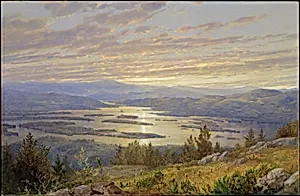
Lake Squam from Red Hill
Medium
Watercolor, gouache, and graphite on light gray-green wove paper
Dimensions
8 7/8 x 13 9/16 in. (22.5 x 34.4 cm)
Classification
Watercolor
Culture
American
Department
The American Wing
Museum
Metropolitan Museum of Art, New York, NY
Credit
Gift of The Reverend E. L. Magoon, D.D., 1880
Accession Number
80.1.6
Rights
Public Domain
Tags
Art Historical Context
William Trost Richards, a prominent 19th-century artist associated with the Hudson River School, captures the serene beauty of New's Lake Squam in 1874 watercolor. Viewed from Red Hill, the composition showcases Richards' mastery of luminous landscapes, emphasizing the interplay of light on water and distant hills. Created during a period when American artists celebrated the nation's natural wonders amid post-Civil War optimism, the work reflects a deep appreciation for the unspoiled wilderness of the White Mountains region. Richards employed watercolor and gouache on light gray-green wove paper, a technique that allowed for translucent washes of color to evoke atmospheric depth, enhanced by graphite underdrawing for precise contours. Gouache added opaque highlights, lending vibrancy to the lake's reflections and foliage. At 8 7/8 x 13 9/16 inches, its intimate scale invites close contemplation, highlighting the watercolor medium's portability—ideal for plein air sketching popular among Hudson River painters. Acquired as a gift from The Reverend E. L. Magoon in 1880 and now housed in The Metropolitan Museum of Art's American Wing, this piece exemplifies the era's cultural reverence for American scenery, bridging Romanticism and emerging Realism in U.S. art. Visitors will appreciate its delicate luminosity, a testament to Richards' enduring influence on landscape traditions.
About the Artist
William Trost Richards · 1833–1905
William Trost Richards (1833–1905) was a prominent American landscape and marine painter born in Philadelphia, where he attended Central High School before beginning his artistic training. Between 1850 and 1855, he studied part-time under the German-born Hudson River School artist Paul Weber while working as a designer and illustrator of ornamental metalwork. He exhibited his first works at the Pe...