
1829 Show Towel
1935/1942
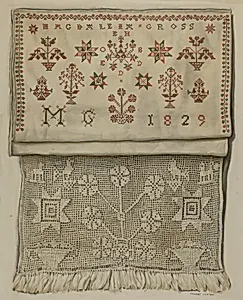
Medium
watercolor and graphite on paperboard
Dimensions
overall: 55.7 x 44.9 cm (21 15/16 x 17 11/16 in.)
Classification
Index of American Design
Department
CG-W
Museum
National Gallery of Art, Washington, D.C.
Credit
Index of American Design
Accession Number
1943.8.15345
Rights
Public Domain
Art Historical Context
Welcome to the National Gallery of, where we explore America's rich folk art heritage through treasures like *1829 Show Towel* by Frances Lichten. Created between 1935 and 1942, this vibrant watercolor and graphite rendering on paperboard (55.7 x 44.9 cm) captures intricate beauty of a traditional Pennsylvania German show towel from 1829 Show towels were prized household linens, often embroidered with elaborate floral motifs, dates, and names to commemorate special occasions, proudly displayed as symbols of craftsmanship and family pride. Lichten's work is part of the Index of American Design, a groundbreaking WPA Federal Art Project from the Great Depression era. This initiative employed artists to document everyday American objects through precise, colorful illustrations, preserving cultural artifacts that might otherwise fade from memory. Watercolor brought the towel's vivid hues to life, while graphite added fine details, making this a faithful study rather than a mere copy—highlighting the anonymous maker's skill in a pre-industrial craft tradition. Today, this piece underscores the artistic value of folk traditions, bridging 19th-century domestic life with 20th-century preservation efforts. It's a delightful reminder of how ordinary items can embody extraordinary cultural stories.
About the Artist
Frances Lichten · 1855–present
Frances Lichten was born in Bellefonte, Pennsylvania, in 1889. At fourteen she enrolled in the Pennsylvania Museum School of Industrial Art, where she studied design and interior decoration, while also pursuing landscape painting at the Pennsylvania Academy of Fine Arts. After graduating she worked as a commercial artist for nearly a decade, building the technical foundation that would later serve...