
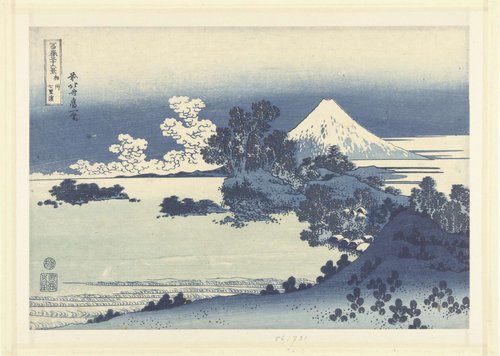
36 gezichten op de berg Fuji
1830 - 1834
Medium
color woodcut
Dimensions
369; 254
Rights
Public Domain
About this artwork
Aankoop met steun van de Vereniging Rembrandt en het Ministerie van Onderwijs, Kunsten en Wetenschappen
Art Historical Context
Katsushika Hokusai’s *36 Views of Mount Fuji* (1830–1834) is one of the most celebrated series in Japanese art history. Created during the late Edo period, the set of color woodblock prints presents Japan’s sacred mountain from a remarkable range of viewpoints, seasons, and weather conditions. Hokusai, a master of the ukiyo-e genre, used the mountain not merely as a landscape subject but as a constant presence that frames scenes of everyday life, travel, and labor. Each print was produced through the demanding woodblock technique, with separate carved blocks for each color—most famously the vivid “Prussian blue” that helped define the series. At roughly 25 × 37 cm, the sheets were affordable enough to reach a broad audience, turning Mount Fuji into a shared national symbol while also introducing Japanese printmaking to the wider world. Acquired with support from the Vereniging Rembrandt and the Dutch Ministry of Education, Arts and Sciences, this work remains a cornerstone of museum collections, inviting visitors to appreciate both its technical brilliance and its quiet meditation on nature’s enduring presence.
About the Artist
Katsushika Hokusai · 1760–1849
Katsushika Hokusai (1760-1849) stands as one of history's most influential artists, a Japanese master who revolutionized the ukiyo-e woodblock print tradition and profoundly shaped Western art. Born in the Katsushika district of Edo (modern-day Tokyo) to an artisan family, Hokusai lived through nearly nine decades of extraordinary creative evolution, adopting over thirty different artistic names t...