
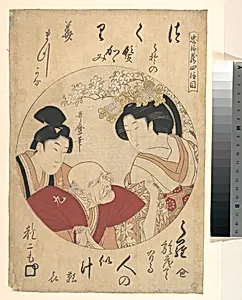
忠臣蔵四段目
ca. 1798
Medium
Woodblock print; ink and color on paper
Dimensions
H. 13 in. (33 cm); W. 8 7/8 in. (22.5 cm); Diam. of circle 8 3/8 in. (21.3 cm)
Classification
Prints
Culture & Period
Japan · Edo period (1615–1868)
Department
Asian Art
Museum
Metropolitan Museum of Art, New York, NY
Credit
Gift of Estate of Samuel Isham, 1914
Accession Number
JP987
Rights
Public Domain
Tags
Art Historical Context
Step into the vibrant world of Edo-period Japan with Kitagawa Utam's *Chūshingura: Act Four* (ca. 1798), a captivating woodblock print from the ukiyo-e tradition, meaning "pictures of the floating world."amaro, a master of bijin-ga (images of beautiful women), here turns his gaze to the iconic kabuki drama *Chūshingura*, the tale of the loyal 47 ronin avenging their lord's death. This fourth act likely captures dramatic tension among key characters—men and women intertwined with delicate flowers—evoking themes of honor, loyalty, and fleeting beauty that resonated deeply in 18th-century Japanese society. Printed with ink and color on paper, the work showcases ukiyo-e's revolutionary techniques: intricate woodblocks carved by specialists allowed for bold, layered colors and fine details, making art accessible beyond elites. At 13 x 8⅞ inches (with a circular format suggesting a fan or album leaf), its intimate scale draws viewers close, highlighting Utamaro's signature elegance in poses and expressions. Produced during the Edo period (1615–1868), when urban culture flourished in cities like Edo (modern Tokyo), such prints immortalized kabuki stars and fed a booming market for affordable luxury. Today, this gem from the Metropolitan Museum of Art's Asian Art collection reminds us of ukiyo-e's global influence, inspiring later artists like Van Gogh. It beautifully blends storytelling, sensuality, and craftsmanship, inviting you to ponder the timeless drama of duty and desire.
About the Artist
Kitagawa Utamaro · 1753–1806
Kitagawa Utamaro (c. 1753-1806) was one of the most celebrated masters of ukiyo-e woodblock printing, revolutionizing the art of bijin-ga (pictures of beautiful women) during Japan's Edo period. Born Kitagawa Ichitaro, his early life remains shrouded in mystery, with conflicting accounts placing his birth in Kyoto, Osaka, Yoshiwara in Edo (modern Tokyo), or Kawagoe in Musashi Province. Under the t...