
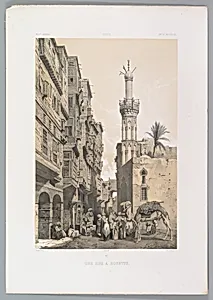
88. Une rue, à Rosette
Medium
Lithograph
Dimensions
Sheet: 22 3/8 × 15 5/8 in. (56.9 × 39.7 cm)
Classification
Prints
Department
Photographs
Museum
Metropolitan Museum of Art, New York, NY
Credit
Joyce F. Menschel Photography Library Fund, 2017
Accession Number
2017.66.21
Rights
Public Domain
Art Historical Context
Step into the bustling streets of 19th-century Egypt with *88. Une rue, à Rosette* (1843), a captivating lithograph by French artist and pioneering photographer Joseph-Philibertault de Prangey. This print depicts a sunlit street in Rosetta (modern Rashid), a Nile Delta port city famed for the discovery of the Rosetta Stone. Girault de Prangey, an archaeologist and traveler, captured such scenes during his groundbreaking 1839–1842 expedition across the Middle East and North Africa blending artistic observation with emerging photographic innovation. As one of the earliest photographers to document the Orient, Girault de Prangey used the daguerreotype process to record over 1,000 views before photography was widely reproducible. He translated these into lithographs—prints made by drawing on limestone with greasy crayons, inked, and pressed onto paper—allowing broader access to his vivid imagery. Produced just four years after daguerreotypy's invention, this work exemplifies the era's "Orientalist" fascination, bridging painting, printmaking, and proto-photography. Housed in The Metropolitan Museum of Art's Photographs Department, *Une rue, à Rosette* highlights how lithographs democratized exotic vistas, influencing travel literature and Western perceptions of the Islamic world. A window into a vanishing architectural landscape, it invites us to ponder the dawn of visual documentation. (198 words)
About the Artist
Joseph-Philibert Girault de Prangey · 1804–1892
Joseph-Philibert Girault de Prangey (1804–1892), born in Langres, France, as the sole surviving child of Claude Joseph Girault and Barbe Philiberte Rosine Piétrequin, inherited the lordships of Genevrières and Prangey, adopting his full surname in 1825. After studies at Langres college and in Paris, where he earned baccalauréats in letters (1826) and law (1828), he pursued artistic training under ...