
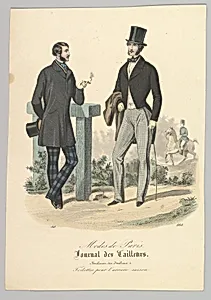
888 from Modes de Paris, Journal des Tailleurs
Medium
Hand-colored lithograph
Dimensions
sheet: 10 1/16 x 7 in. (25.5 x 17.8 cm)
Classification
Prints
Department
Drawings and Prints
Museum
Metropolitan Museum of Art, New York, NY
Credit
Museum Accession
Accession Number
x.15.18
Rights
Public Domain
Tags
Art Historical Context
Step into the elegant world of 1840s Parisian fashion with *888 from Modes de Paris, Journal desailleurs*, a hand-coloredograph capturing the refined style of French gentlemen. Published in 1848 amid the revolutionary fervor of the Second Republic, this print from a popular tailors' journal showcases men's attire—likely featuring tailored coats, trousers, and accessories—while highlighting the era's growing fascination with smoking, as men leisurely puff on pipes or cigars. These fashion plates were essential for disseminating the latest trends from Paris, the unrivaled capital of style, to tailors and dandies across Europe. The medium of hand-colored lithography was revolutionary for its time, allowing affordable mass production of vivid, detailed illustrations. Artists drew directly on limestone slabs for precise lines, then skilled colorists added washes of watercolor by hand, bringing fabrics and textures to life on the small 10 x 7-inch sheet. This anonymous work exemplifies the *Modes de Paris* series' role in democratizing high fashion, offering a colorful snapshot of mid-19th-century masculinity, where sophistication met emerging leisure habits like smoking. Today, housed in the Metropolitan Museum of Art's Drawings and Prints department, it reminds us how prints like this preserved cultural ideals, influencing wardrobes from London to New York. A delightful glimpse into history's wardrobe!
About the Artist
Anonymous, French, 19th century · 1800–1900
**Anonymous, French, 19th Century (ca. 1800–1900)** The artist cataloged as Anonymous, French, 19th century embodies the enigmatic yet essential contributions of unidentified creators to France's vibrant 19th-century art world. Active roughly between 1800 and 1900, this figure—or potentially collective workshop—produced a diverse array of works amid the nation's transition from Neoclassicism thro...