
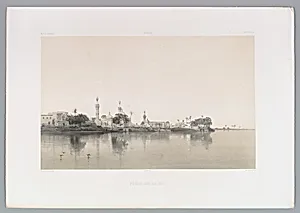
95. Foûah, sur le Nil
Medium
Lithograph
Dimensions
Sheet: 22 3/8 × 15 5/8 in. (56.9 × 39.7 cm)
Classification
Prints
Department
Photographs
Museum
Metropolitan Museum of Art, New York, NY
Credit
Joyce F. Menschel Photography Library Fund, 2017
Accession Number
2017.66.18
Rights
Public Domain
Art Historical Context
Joseph-Philibert Girault de Prangey created this striking lithograph, titled *95. Foûah, sur le Nil*, in 1843 during a period of intense European fascination with Egypt and the Nile River. As a French artist and early photographer, Girault de Prangey traveled extensively through the Middle East in the 1840s, documenting ancient sites and everyday landscapes. This work captures the town of Fouah along the Nile, offering viewers a glimpse of Egyptian life and scenery that was still relatively unfamiliar to Western audiences at the time. The choice of lithography as the medium is particularly significant. This printmaking technique allowed for fine detail and tonal range, making it an ideal bridge between traditional drawing and the emerging technology of photography. Housed in the Metropolitan Museum’s Photographs department despite its classification as a print, the lithograph reflects how 19th-century artists used multiple reproductive methods to share their observations of distant cultures. Measuring over 22 inches tall, the large sheet would have made an impressive impression when first published, inviting museum visitors today to consider both the artistic and exploratory spirit of the era.
About the Artist
Joseph-Philibert Girault de Prangey · 1804–1892
Joseph-Philibert Girault de Prangey (1804–1892), born in Langres, France, as the sole surviving child of Claude Joseph Girault and Barbe Philiberte Rosine Piétrequin, inherited the lordships of Genevrières and Prangey, adopting his full surname in 1825. After studies at Langres college and in Paris, where he earned baccalauréats in letters (1826) and law (1828), he pursued artistic training under ...