
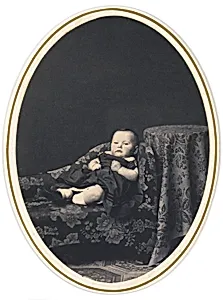
A Baby
ca. 1860
Medium
Photography-Photoprint
Classification
Photography-Photoprint
Department
Smithsonian Collection
Museum
Smithsonian American Art Museum
Credit
Smithsonian American Art Museum, Museum purchase from the Charles Isaacs Collection made possible in part by the Luisita L. and Franz H. Denghausen Endowment
Accession Number
1994.91.96
Rights
Public Domain
Tags
Art Historical Context
**A Baby** (ca. 1860) captures a tender moment in early photography, created by the Philadelphia studio Jones and Brother, active during the 1860s. This photoprint, a full-length portrait of an infant, exemplifies the burgeoning art of studio photography in mid-19th-century America. Produced using the wet-collodion process—then the gold standard for sharp, detailed prints—the image reflects the technical precision and accessibility that made photography a popular medium for family documentation. In the Victorian era, photographing babies was a cherished practice, often commissioned by middle-class families to preserve fleeting childhood moments amid high infant mortality rates. Jones and Brother's work from Philadelphia, a hub of early American photography, highlights how studios transformed personal milestones into enduring art. The full-length composition, likely posing the baby on a surface for stability, adds a sense of scale and intimacy rare in portraiture of the time. Acquired by the Smithsonian American Art Museum through the Charles Isaacs Collection, this piece underscores photography's role in democratizing portraiture, bridging fine art and everyday life. Visitors will appreciate its quiet charm, a window into 1860s domesticity.