
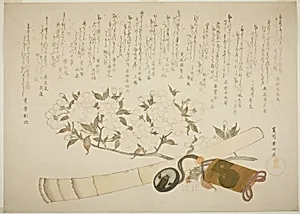
A Branch of White Peach Blossom, an Inro case, and a Hotchiku Flute
early 19th century
Medium
Color woodblock print; surimono
Dimensions
40.5 × 56.4 cm (15 15/16 × 22 3/16 in.)
Classification
woodblock print
Department
Arts of Asia
Museum
Art Institute of Chicago
Accession Number
81222
Rights
Public Domain
Art Historical Context
This elegant color woodblock print by Hishikawa Sori III presents a refined still-life arrangement of a white peach blossom branch, a lacquered inro case, and a hotchiku bamboo flute. Created in the early 19th century as a surimono—a privately commissioned print typically exchanged among poets and scholars—the work showcases the artist’s precise observation of natural forms alongside objects of daily refinement. The generous dimensions allow for delicate details, such as the soft petals and the flute’s textured surface, to emerge through the medium’s layered pigments. Surimono prints like this one were valued for their luxurious production, often incorporating embossing, metallic inks, and subtle color gradations that elevated them beyond standard commercial ukiyo-e. Hishikawa Sori III worked within the long-established Hishikawa lineage, blending naturalistic depiction with the poetic sensibility popular in Edo-period Japan. The peach blossoms evoke early spring renewal, while the inro and flute suggest personal cultivation and quiet appreciation of the arts. Housed in the Art Institute of Chicago’s Arts of Asia collection, the print offers modern viewers a glimpse into the refined cultural exchanges of its time.
About the Artist
Hishikawa Sori III
**Hishikawa Sori III** (also known as Tawaraya Sori or Rinsai Soji) was a Japanese ukiyo-e painter and print artist active primarily from the late 1790s to around 1813. He is best remembered as an early and successful pupil of the master Katsushika Hokusai, who bestowed upon him the artist name Hishikawa Sori in 1798 (the artist had previously worked under the name Tawaraya Soji). Sori III worked...