
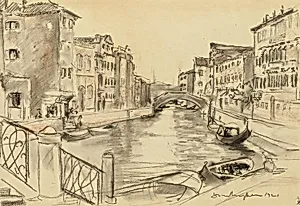
A Canal at Venice
Medium
Drawing
Classification
Drawing
Department
Smithsonian Collection
Museum
Smithsonian American Art Museum
Credit
Smithsonian American Art Museum, Gift of Moune G.H. Webster
Accession Number
1974.85.12
Rights
Public Domain
Tags
Art Historical Context
In the serene *A Canal at Venice* (1921), Canadian-American artist Donald Shaw Maclan captures the timeless allure of Venice's watery labyrinth. This delicate drawing depicts a classic canal scene, complete with a gliding gondola, arched bridge, and gently bobbing boat, evoking the city's romantic, sun-dappled charm. Created just after World War I, the work reflects a period when artists flocked to Venice for inspiration, drawn to its shimmering light and architectural poetry amid Europe's fragile recovery. MacLaughlan, renowned for his precise yet atmospheric renderings of European landscapes, employs the intimate medium of drawing to masterful effect. Unlike bolder oils or prints, drawings like this allow for subtle line work and tonal shading, emphasizing fleeting moods and intricate details—think the ripple of water or the curve of a gondola's prow. Housed in the Smithsonian American Art Museum through a generous gift from Moune G.H. Webster, it highlights early 20th-century American fascination with Old World beauty. This piece invites visitors to pause and imagine the lapping waves and distant calls of gondoliers, a poignant reminder of Venice's enduring cultural magic.
About the Artist
Donald Shaw MacLaughlan · 1876–1938
Donald Shaw MacLaughlan (1876–1938) was born on November 9 in Charlottetown, Prince Edward Island, Canada, though he is recognized as an American artist after his family relocated to Boston, Massachusetts, in 1890. There, as a teenager, he immersed himself in the Boston Public Library's collections of old master prints, studying works by Albrecht Dürer, Rembrandt van Rijn, and eighteenth-century E...