
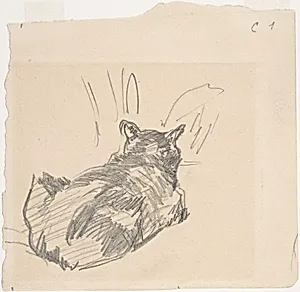
A Cat Resting on All Fours, Seen from Behind
1861
Medium
Graphite, on ivory-colored paper
Dimensions
3 3/4 x 4 13/16 in. (9.5 x 12.2 cm)
Classification
Drawings
Department
Drawings and Prints
Museum
Metropolitan Museum of Art, New York, NY
Credit
Purchase, Gift of Paul Gourary in honor of Marianne Gourary's birthday, 1995
Accession Number
1995.494
Rights
Public Domain
Tags
Art Historical Context
In the intimate world of Edouard Manet's sketches, *A Cat Resting on All Fours, Seen from Behind* (1861) captures a moment of quiet feline repose. Rendered in graphite on ivory-colored paper this delicate drawing measures just 3 3/4 x 4 13/16 inches, inviting close inspection. Manet, a pivotal French artist bridging Realism and Impressionism, often turned to everyday subjects with a fresh, modern gaze—here, the cat's arched back and poised stance, viewed from an unusual rear angle, reveal his keen observation of nature's subtle forms. Created during Manet's formative years in Paris, when he was honing techniques amid the vibrant art scene, this work exemplifies his mastery of graphite's fluid lines and tonal shading. Unlike his bolder oil paintings, such as those scandalizing the Salon, this sketch feels personal, perhaps a study from life reflecting his fondness for cats, which appear recurrently in his oeuvre. The modest scale underscores the spontaneity of 19th-century drawing as both practice and poetry. Today, housed in the Metropolitan Museum of Art's Drawings and Prints department (acquired in 1995), it reminds us of art's playful side—cats as muses for geniuses, blending domestic charm with artistic innovation. A purr-fect gem for cat lovers and Manet enthusiasts alike!
About the Artist
Edouard Manet · 1832–1883
Édouard Manet (1832-1883) was a French painter who played a pivotal role in the transition from Realism to Impressionism, often called the 'Father of Modern Art.' Born into a wealthy Parisian family, Manet defied his father's wishes for a legal career to pursue painting, studying under academic artist Thomas Couture. His revolutionary works 'Le Déjeuner sur l'herbe' and 'Olympia' (both 1863) scand...