
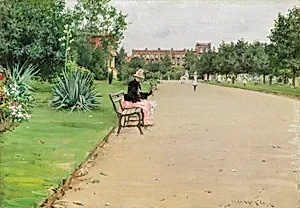
A City Park
c. 1887
Medium
Oil on canvas
Dimensions
34.6 × 49.9 cm (13 5/8 × 19 5/8 in.)
Classification
painting
Department
Arts of the Americas
Museum
Art Institute of Chicago
Accession Number
28849
Rights
Public Domain
About this artwork
In the late 1880s, William Merritt Chase painted a series of works focused on the public parks of Brooklyn and Manhattan, including A City Park. Amid rapid growth in New York and other US cities, such green spaces offered respite as well as novel venues for social activity. Inspired by the works of French Impressionism, Chase experimented with dramatic spatial effects, open brushwork, and a high-keyed palette. The composition’s small scale suggests that the artist painted the canvas outdoors, op...
Art Historical Context
William Merritt Chase’s * City Park* (c 1887) captures a tranquil urban oasis with the loose brushwork and luminous color typical of American Impressionism. As one of the leading figures who introduced European Impressionist ideas to the United States, Chase often turned his attention to public parks in New York, where newly created green spaces offered city dwellers a respite from rapid industrialization. The modest scale of this oil-on-canvas work—roughly 14 by 20 inches—invites an intimate viewing experience, allowing the play of light across paths, foliage, and figures to unfold quietly. The painting reflects the broader cultural shift toward public parks as democratic spaces for leisure and social mixing in the late nineteenth century. Chase’s fluid technique, with its emphasis on atmospheric effects rather than precise detail, conveys the fleeting quality of sunlight filtering through trees and the gentle movement of strollers. Displayed today in the Art Institute of Chicago’s Arts of the Americas collection, the work continues to illustrate how American artists adapted Impressionism to celebrate both the natural beauty and the modern vitality of their own cities.
About the Artist
William Merritt Chase · 1849–1916
Prolific painter of portraits, interiors, still lifes and landscapes, famed for establishing the fresh colour and bravura technique used in much early 20th-century American painting. He was considered the most important American teacher of his time; after teaching at the Art Students League of NY he formed the Chase School of Art in 1896. Comment on works: genre, Portraits