
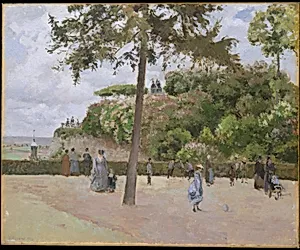
The Public Garden at Pontoise
1874
Medium
Oil on canvas
Dimensions
23 5/8 x 28 3/4 in. (60 x 73 cm)
Classification
Paintings
Department
European Paintings
Museum
Metropolitan Museum of Art, New York, NY
Credit
Gift of Mr. and Mrs. Arthur Murray, 1964
Accession Number
64.156
Rights
Public Domain
Tags
Art Historical Context
Camille Pissarro's *The Public Garden at Pontoise* (1874), an oil on canvas measuring 23⅝ × 28¾ inches, invites visitors into a sun-dappled corner of everyday French life. Painted during Pissarro's residence in the rural town of Pontoise, northwest of Paris, the work captures a public garden alive with strolling figures amid lush greenery and winding paths. This scene reflects the artist's fascination with ordinary moments, blending human activity with the natural world in a harmonious, light-filled composition. As a founding father of Impressionism, Pissarro pioneered techniques like loose, vibrant brushstrokes and en plein air painting to convey the transient effects of sunlight and atmosphere. Departing from the polished finishes of academic art, his approach emphasized color over line, influencing peers like Monet and Renoir. Here, dappled shadows and earthy tones evoke the warmth of a leisurely afternoon, showcasing Impressionism's revolutionary focus on perception and modernity. Acquired by the Metropolitan Museum of Art in 1964 as a gift from Mr. and Mrs. Arthur Murray, this painting exemplifies Pissarro's commitment to rural France amid the Industrial Age. It remains a testament to how art can celebrate the beauty in the commonplace, drawing us closer to 19th-century life.
About the Artist
Camille Pissarro · 1831–1903
Camille Pissarro (1830-1903) stands as the patriarch of Impressionism, the only artist to exhibit in all eight Impressionist exhibitions and a mentor whose influence shaped the trajectory of modern art. Born Jacob Abraham Camille Pissarro on the Caribbean island of St. Thomas to a Jewish-Portuguese merchant family, he abandoned the family business to pursue painting, eventually settling in Paris i...