
A Classical Temple
c. 1780
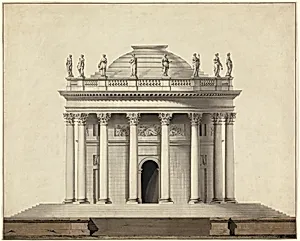
Medium
pen and black ink with gray, brown, and green washes on laid paper
Dimensions
overall: 41.5 x 51.2 cm (16 5/16 x 20 3/16 in.)
Classification
Drawing
Department
CG-E
Museum
National Gallery of Art, Washington, D.C.
Credit
Gift of William B. O'Neal, in Honor of the 50th Anniversary of the National Gallery of Art
Accession Number
1991.150.70
Rights
Public Domain
Art Historical Context
Louis Gustave Taraval’s *A Classical Temple* (c. 1780) captures the era’s deep fascination with ancient architecture during the rise of Neoclassicism. Created just before the French Revolution, the drawing reflects Enlightenment ideals that celebrated the harmony, proportion, and civic virtue of Greco-Roman forms. Taraval, a French draftsman of Swedish birth, often explored such subjects as both artistic exercises and designs for decorative schemes, aligning with the period’s renewed interest in antiquity as a source of moral and aesthetic inspiration. Executed in pen and black ink with delicate gray, brown, and green washes on laid paper, the work demonstrates Taraval’s skillful use of wash to suggest light, shadow, and atmospheric depth. This fluid medium allowed artists to evoke the solidity of stone while hinting at the surrounding landscape, giving the imagined temple a sense of both grandeur and serenity. At roughly 41.5 by 51.2 centimeters, the sheet’s generous scale invites close contemplation of its architectural details. Now part of the National Gallery of Art’s collection through a generous gift, the drawing offers today’s visitors a window into 18th-century tastes and the enduring appeal of classical ideals.
About the Artist
Louis Gustave Taraval · 1738–1794
Taraval served as inspector for the Bâtiments du Roi. According to Macmillan, he was influential in the publication of several important architects, including Pierre Contant D'Ivry and Jean François Chalgrin.