
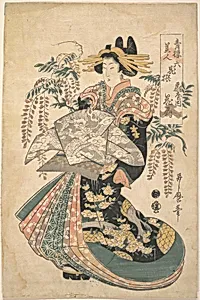
青楼美人 六花撰 扇屋内花扇|A Courtesan with Wisteria on the Background
Medium
Woodblock print; ink and color on paper
Dimensions
H. 14 1/8 in. (35.9 cm); W. 9 1/4 in. (23.5 cm)
Classification
Prints
Culture & Period
Japan · Edo period (1615–1868)
Department
Asian Art
Museum
Metropolitan Museum of Art, New York, NY
Credit
Museum Accession
Accession Number
JP1090
Rights
Public Domain
Tags
Art Historical Context
In the vibrant world of Edo-period Japan (1615–8), woodblock prints like *A Courtesan withisteria on the Background captured the "floating world" of urban pleasures. Created by Utamaro II, a talented pupil of the renowned ukiyo-e master Kitagawa Utaro, this print belongs to the bijin-ga tradition—elegant depictions of beautiful women. Part of the series *Rokka-sen* (Six Flowers) from the Ogi-ya pleasure house, it showcases a courtesan amid cascading wisteria, evoking the seasonal beauty and fleeting allure of the Yoshiwara district's entertainment quarters. The artwork's medium—ink and color on paper, measuring about 14 by 9 inches—highlights the ingenuity of ukiyo-e woodblock printing. Artisans carved separate blocks for each color, layering vibrant hues with precise registration to achieve delicate gradients and textures, from the courtesan's flowing kimono to the blossoms' soft petals. This affordable technique democratized art, making sophisticated imagery accessible beyond elites. Culturally, such prints celebrated women's grace while reflecting Japan's fascination with nature's ephemerality—wisteria symbolizing spring's transience. Housed in the Metropolitan Museum of Art's Asian Art collection, it offers a window into Edo society's blend of sensuality, artistry, and impermanence, inviting visitors to ponder beauty's brief bloom.