
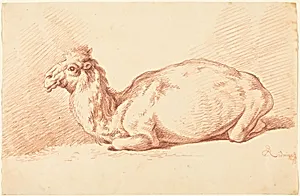
A Dromedary Camel
Medium
red chalk on laid paper
Dimensions
overall: 19.9 x 30.6 cm (7 13/16 x 12 1/16 in.)
Classification
Drawing
Department
CG-E
Museum
National Gallery of Art, Washington, D.C.
Credit
Ailsa Mellon Bruce Fund
Accession Number
1998.70.1
Rights
Public Domain
Art Historical Context
Johann Elias Ridinger, a masterful German artist and engraver of the th century, captures the majestic form of a dromedary in this exquisite drawing from the 1750s. Known for his intricate depictions of animals—particularly horses and exotic creatures—Ridinger blended scientific precision with artistic flair during the Enlightenment era, when European fascination with natural history and lands was at its peak. This one-humped camel, native to arid regions of the Middle East and North Africa, symbolizes endurance and the exotic trade routes that connected continents. Executed in red chalk on laid paper, the work showcases Ridinger's skillful use of sanguine—a warm, earthy medium prized for its soft tonal gradations and ability to render fur, muscle, and contour with lifelike subtlety. At 19.9 x 30.6 cm, the intimate scale invites close inspection of the camel's poised stance and textured hide, likely a preparatory study for one of Ridinger's renowned engravings or illustrated volumes on fauna. Housed in the National Gallery of Art through the Ailsa Mellon Bruce Fund, this drawing highlights Ridinger's enduring legacy in animalier art, bridging Baroque dynamism with emerging naturalism. It offers visitors a window into 18th-century curiosity about the world's wonders, reminding us how art documented the unknown.
About the Artist
Johann Elias Ridinger · 1698–1767
Johann Elias Ridinger (1698–1767) was born in Ulm into an artistic family, the son of scribe and artist Johann Daniel Ridinger and Regina Catharina Miller. He received his initial training in Ulm under the painter Christoph Resch, who instructed him in perspective, geometry, and architecture while assigning preparatory tasks like painting wax models. Around 1713, Ridinger moved to Augsburg, where ...