
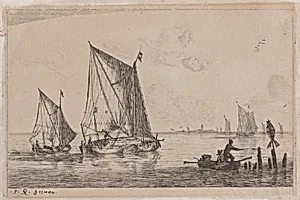
A "Duinopschuit," a Smaller Sailing Boat, and a Rowboat
c. 1656
Medium
etching on laid paper
Dimensions
plate: 13.5 × 20.6 cm (5 5/16 × 8 1/8 in.) sheet: 15 × 22 cm (5 7/8 × 8 11/16 in.)
Classification
Department
CG-E
Museum
National Gallery of Art, Washington, D.C.
Credit
Gift of Dr. Klaus Anselm
Accession Number
2018.28.5
Rights
Public Domain
Art Historical Context
In the mid-17th century, during the Dutch Golden Age, artist Reinier Nooms—better known as Zeeman, "sailor"—ured the bustling maritime world of the Netherlands in intricate etchings like *A "Duinopschuit," a Smaller Sailing Boat and a Rowboat*c. 1656). This print on laid paper depicts everyday vessels central to Dutch trade and coastal life: the *duinopschuit*, a specialized sand dredger for maintaining waterways; a nimble sailing boat; and sturdy rowboat. Nooms, a former sailor himself, brought authentic detail to these scenes, reflecting the Republic's dominance in global shipping and naval prowess amid the Anglo-Dutch Wars. Etching allowed Nooms to excel in fine lines and textures, rendering the ships' rigging, hulls, and rippling water with remarkable precision on a modest plate of 13.5 × 20.6 cm. As a printmaker, he made these works accessible beyond oil paintings, popular among collectors for their documentary quality. This piece exemplifies the Dutch fascination with *zee- en havenstukken* (sea and harbor pieces), celebrating economic vitality and seafaring ingenuity. Today, housed in the National Gallery of Art as a gift from Dr. Klaus Anselm (Department CG-E), it invites visitors to ponder the unsung heroes of Holland's watery empire—those who navigated dunes, seas, and dunes alike.
About the Artist
Reinier Nooms, called Zeeman · 1623–1664
Reinier Nooms, known as Zeeman ("sailor" in Dutch), was a prominent Dutch maritime painter, draftsman, and etcher of the Golden Age, born around 1623 or 1624 in Amsterdam and dying there in 1664 at about age 40. Before turning to art around 1643, he led a rough life as a professional seaman, which informed his unparalleled accuracy in depicting ships, ports, naval battles, and coastal scenes—knowl...