
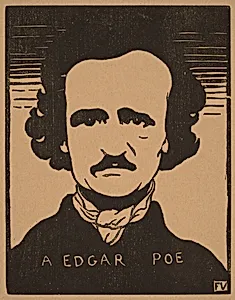
A Edgar Poe
1894
Medium
woodcut on brown wove paper
Dimensions
plate: 15.9 x 12.2 cm (6 1/4 x 4 13/16 in.) sheet: 32.5 x 14.5 cm (12 13/16 x 5 11/16 in.)
Classification
Department
CG-E
Museum
National Gallery of Art, Washington, D.C.
Credit
Gift of Frank Anderson Trapp
Accession Number
2003.118.28
Rights
Public Domain
Art Historical Context
Félix Vallotton's *À Edgar Poe* (1894) is a striking woodcut portrait that captures the brooding intensity of the American literary icon Edgar Allan Poe. Vallotton, a Swiss-born artist and key member of the Nabis group, revolutionized printmaking in fin-de-siècle France with precise, high-contrast woodcuts. This small-scale work (plate: 15.9 x 12.2 cm) on brown wove paper evokes Poe's gothic mystique—his sharp features and piercing gaze emerging from deep shadows, perfectly suiting the master of macabre tales like *The Raven*. Vallotton's technique exemplifies the Nabis' admiration for Japanese ukiyo-e prints, blending bold blacks and whites with unflinching realism. Carved directly into wood blocks, these prints demand meticulous craftsmanship, resulting in crisp lines and dramatic flatness that reject soft engraving traditions. Created amid Symbolist fascination with the irrational and the uncanny, the piece reflects late 19th-century Europe's romanticized view of Poe as a tormented genius. Housed in the National Gallery of Art (gift of Frank Anderson Trapp), this print highlights Vallotton's brief but brilliant woodcut phase (1891–98), bridging Impressionism and modernism. Visitors will appreciate its intimate scale, inviting close inspection of the artist's virtuosic control over light and form.
About the Artist
Félix Vallotton · 1865–1925
Félix Vallotton (1865–1925) was born in Lausanne, Switzerland, into a comfortable middle-class family, and moved to Paris in 1882 to enroll at the Académie Julian, where he studied under the portrait painter Jules Joseph Lefebvre and the history painter Gustave Boulanger. Paris would remain his home for the rest of his life, and he became a French citizen in 1900 following his marriage to the art ...