
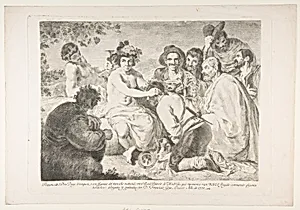
A False Bacchus Crowning Drunkards
Medium
Etching
Dimensions
Plate: 12 5/8 × 17 1/8 in. (32 × 43.5 cm) Sheet: 14 1/8 × 20 1/2 in. (35.8 × 52 cm)
Classification
Prints
Department
Drawings and Prints
Museum
Metropolitan Museum of Art, New York, NY
Credit
Harris Brisbane Dick Fund, 1924
Accession Number
24.97.1
Rights
Public Domain
Tags
Art Historical Context
In the vibrant world of 18th-century Spanish art, *A False Bacchus Crowning Drunkards* stands as a striking etching attributed to both Diego Velázquez and Francisco de Goya, dated 1778. Created during Goya's early career, just as he was rising in Madrid's artistic circles, this print likely draws inspiration from Velázquez's earlier masterpiece *The Triumph of Bacchus* (also known as *Los Borrachos*), where the Roman god of wine crowns revelers. Goya's rendition, marked by the satirical title "A False Bacchus," cleverly twists this classical myth into a critique of excess, vividly capturing men lost in drunken revelry through tags like "Drunkenness" and "Drinking." Etching, the medium here, was a revolutionary technique for its time, allowing artists like Goya to produce detailed, tonal images from copper plates using acid bites for intricate lines. Measuring 12 5/8 × 17 1/8 inches on the plate, this work exemplifies printmaking's democratic power—multiples could reach wider audiences beyond elite patrons. Housed in the Metropolitan Museum of Art's Drawings and Prints department, acquired via the Harris Brisbane Dick Fund in 1924, it showcases Goya's budding genius for social commentary. This piece invites us to ponder timeless vices amid Enlightenment-era Spain, where Goya's sharp eye foreshadowed his later masterpieces like *Los Caprichos*. A playful yet pointed reminder: even gods of merriment can expose human folly.
About the Artist
Velázquez (Diego Rodríguez de Silva y Velázquez)|Goya (Francisco de Goya y Lucientes) · 1599–1660
Diego Rodríguez de Silva y Velázquez, baptized on June 6, 1599, in Seville, Spain, emerged as one of the supreme masters of the Spanish Baroque. The eldest son of notary Juan Rodríguez de Silva and Jerónima Velázquez, he displayed prodigious talent early on. At around age 11 or 12, he apprenticed under Francisco Pacheco, the esteemed Sevillian painter, theorist, and writer whose studio functioned ...