
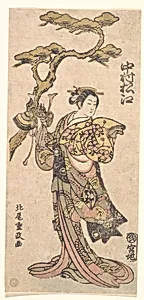
A Famous Actor of Women's Roles
ca. 1764
Medium
Woodblock print; ink and color on paper
Dimensions
H. 11 1/8 in. (28.3 cm); W. 5 1/8 in. (13 cm)
Classification
Prints
Culture & Period
Japan · Edo period (1615–1868)
Department
Asian Art
Museum
Metropolitan Museum of Art, New York, NY
Credit
Rogers Fund, 1921
Accession Number
JP1269
Rights
Public Domain
Tags
Art Historical Context
In the vibrant world of Edo-period Japan (1615–1868), Kitao Shigem's woodblock print *A Famous Actor of Women's* (ca. 1764) captures the allure of kabuki theater. This intimate print, measuring just 11⅛ × 5⅛ inches, depicts a celebrated *onnagata*—a actor renowned for portraying women with graceful poise. Surrounded by delicate trees, the figure embodies the theatrical glamour that captivated urban audiences in 18th-century Tokyo (then Edo). Shigemasa, a master of the ukiyo-e ("pictures of the floating world") style, elevated everyday celebrities like actors into icons of popular culture. Woodblock printing, using ink and color on paper, was a revolutionary technique that made art accessible to the masses. Shigemasa's precise lines and subtle color layering—likely a *nishiki-e* or "brocade print"—highlight the actor's flowing robes and serene expression, blending realism with stylized beauty. These prints often served as fan inserts or album leaves, preserving fleeting moments of fame. Housed in the Metropolitan Museum of Art's Asian Art Department (Rogers Fund, 1921), this work reflects kabuki's cultural dominance and the *onnagata*'s pivotal role in challenging gender norms through performance. It's a window into Japan's playful, print-driven entertainment revolution.
About the Artist
Kitao Shigemasa · 1739–1820
Kitao Shigemasa (1739–1820), born in the bustling Nihonbashi district of Edo (modern Tokyo), emerged as a pivotal figure in ukiyo-e woodblock printing during Japan's Edo period. The eldest son of the bookseller Suharaya Mohei—from a lineage of publishers—Shigemasa, originally named Kitabatake Tarōkichi, was immersed in the world of printing from youth. Largely self-taught, he later studied under t...