
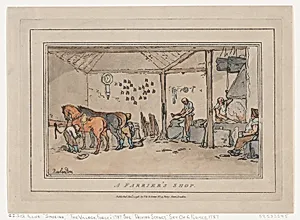
A Farrier's Shop
January 1, 1798
Medium
Hand-colored etching and aquatint
Dimensions
Sheet: 7 13/16 × 10 11/16 in. (19.9 × 27.2 cm) Plate: 6 7/8 × 9 13/16 in. (17.4 × 24.9 cm)
Classification
Prints
Department
Drawings and Prints
Museum
Metropolitan Museum of Art, New York, NY
Credit
The Elisha Whittelsey Collection, The Elisha Whittelsey Fund, 1959
Accession Number
59.533.545
Rights
Public Domain
Tags
Art Historical Context
Step into the lively world of *A Farrier's Shop a hand-colored etching andatint created in 1798 by the collaborative talents of Valentine Green, Rupert Green and Thomas Rowlandson. Housed in Metropolitan Museum of Art's Drawings and Prints department, intimate print (sheet size: 7 13/16 × 10 11/16 in.) captures a slice of Georgian England, where farriers—skilled blacksmiths specializing in horseshoeing—plied their trade. The scene buzzes with men at work, horses in need of care, and hints of a bustling market atmosphere, reflecting the vital role of equine labor in 18th-century society. Rowlandson, renowned for his satirical edge and caricatured figures, likely infused the composition with wry humor, while the Greens' engraving expertise brought precision to the details. Etching provided sharp lines for outlines, aquatint added rich tonal gradients mimicking washes, and meticulous hand-coloring lent vibrant life to the forge's glow and the animals' coats. This print not only showcases innovative mixed-media techniques popular in late 18th-century British printmaking but also preserves a vanishing world of craftsmanship amid urbanization. A charming window into pre-industrial life, it invites us to appreciate the unsung heroes who kept Britain's horses—and its economy—on the move.
About the Artist
Valentine Green|Rupert Green|Thomas Rowlandson · 1739–1813
**Valentine Green (1739–1813)** was a leading British mezzotint engraver and print publisher whose work helped elevate the medium’s status in 18th-century Britain. Born on 3 October 1739 in Salford Priors near Evesham, Warwickshire, he initially trained for the law but abandoned it after two years in a solicitor’s office. He then studied line engraving under Robert Hancock in Worcester before movi...