
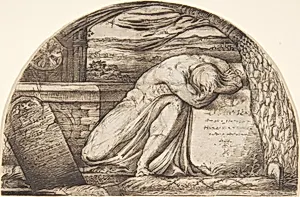
A Figure Weeping Over a Grave
1827 or 1829
Medium
Pen and brown ink over graphite
Dimensions
lunette: 3 1/8 x 5 in. (8 x 12.7 cm)
Classification
Drawings
Department
Drawings and Prints
Museum
Metropolitan Museum of Art, New York, NY
Credit
Harry G. Sperling Fund, 2009
Accession Number
2009.449
Rights
Public Domain
Tags
Art Historical Context
In the intimate lunette-shaped drawing *A Figure Weeping Over Grave* (1827 or 1829), British artist George Richmond captures a moment of profound sorrow. Executed in pen and brown ink over graphite a modest scale—3 1/8 x 5 inches—this work exemplifies the meticulous technique of early 19th-centurysmanship. The graphite underdrawing allowed Richmond to sketch fluidly before refining contours and textures with precise ink lines, lending emotional depth to the solitary mourner's draped form and bowed head. Created when Richmond was in his late teens or early twenties, the piece reflects the Romantic era's fascination with human emotion and mortality. The theme of burial evokes universal grief, rendered with a sensitivity that hints at personal or symbolic resonance amid the period's cultural preoccupation with death—think Gothic literature and elegiac poetry. Its small, curved format suggests it may have been designed for a larger composition or private contemplation, a common practice in preparatory sketches. Today, housed in the Metropolitan Museum of Art's Drawings and Prints department (acquired via the Harry G. Sperling Fund in 2009), this delicate work invites visitors to pause and reflect on the timeless power of loss, preserved in Richmond's masterful lines.
About the Artist
George Richmond · 1809–1896
British, Brompton 1809–1896 London