
Saint Augustine
1660
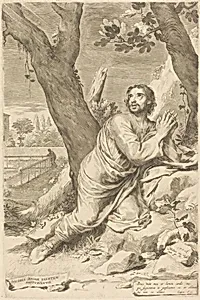
Medium
engraving
Classification
Department
CG-E
Museum
National Gallery of Art, Washington, D.C.
Credit
Ailsa Mellon Bruce Fund
Accession Number
1974.116.14
Rights
Public Domain
Art Historical Context
Claude Mellan's *Saint Augustine* (1660) is a masterful engraving that captures the revered Church Father in a moment of contemplative wisdom. Created during the Baroque era, when religious art flourished amid the Catholic Counter-Reformation, this print exemplifies Mellan's reputation as one of France's premier 17th-century engravers Mellan, active in Paris and Rome, was renowned for his portraits of saints, scholars, and nobility, blending technical precision with expressive depth. The medium of engraving—incising fine lines into a copper plate with a burin—allowed Mellan to achieve remarkable tonal gradations and intricate details, from the saint's flowing robes to his introspective gaze. Prints like this were revolutionary for their reproducibility, enabling widespread devotion and scholarly admiration across Europe at a time when original paintings were rare treasures. Housed in the National Gallery of Art's Department of Prints (CG-E) through the Ailsa Mellon Bruce Fund, *Saint Augustine* invites visitors to ponder the saint's enduring legacy as a theologian whose writings shaped Western Christianity. Mellan's work not only honors Augustine but also showcases engraving's power to make the divine accessible and intimate.
About the Artist
Claude Mellan · 1598–1688
Claude Mellan (1598-1688) was a French draughtsman, engraver, and painter who became one of the most innovative printmakers of the French Baroque period. Born in Abbeville to a family of coppersmiths, Mellan rose to become Peintre et Graveur Ordinaire du Roi (Painter and Engraver in Ordinary to the King), achieving recognition for his extraordinary technical mastery. Mellan's artistic significanc...