
A Fortified Town in Italy
1744/1750
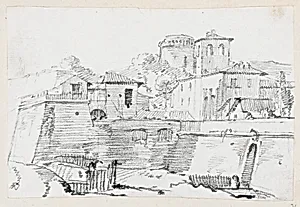
Medium
graphite on laid paper
Dimensions
sheet: 12.6 x 18.9 cm (4 15/16 x 7 7/16 in.) page size: 42.5 x 27.7 cm (16 3/4 x 10 7/8 in.)
Classification
Drawing
Department
CG-E
Museum
National Gallery of Art, Washington, D.C.
Credit
Mark J. Millard Architectural Collection
Accession Number
1983.49.184
Rights
Public Domain
Art Historical Context
Joseph-Marie Vien's *A Fortified Town in Italy* (1744/1750) is a delicate graphite drawing on laid paper, capturing the sturdy silhouette of an Italian hill town with its protective walls, towers, and clustered buildings. Measuring just 12.6 x 18.9 cm, this intimate sketch exemplifies Vien's early fascination with Italy's architectural heritage during his formative years as a French artist. Vien, a pivotal figure bridging Rococo elegance and emerging Neoclassicism, won the prestigious Prix de Rome in 1743, sending him to Italy from 1744 to around 1753—precisely when this work was created. Rendered in graphite, the drawing showcases precise line work and subtle tonal modeling, techniques that allowed Vien to study light, shadow, and form en plein air or from direct observation. Laid paper, with its textured chain lines, was a favored support for such preparatory studies, providing a tactile surface ideal for detailed architectural renderings. This piece reflects the Grand Tour tradition, where artists documented classical and medieval landscapes to inform future paintings. Housed in the National Gallery of Art's Mark J. Millard Architectural Collection (Department CG-E), the drawing highlights Vien's role in revitalizing French art through authentic Italian motifs, influencing later Neoclassicists like Jacques-Louis David. A window into 18th-century artistic travel, it invites visitors to trace the roots of modern landscape depiction.
About the Artist
Joseph-Marie Vien · 1716–1809
Joseph-Marie Vien (1716–1809) was born on 18 June in Montpellier, France, into a modest family, emerging as a child prodigy in painting. As a protégé of the Comte de Caylus, he entered the studio of Charles-Joseph Natoire at an early age, honing his skills in history painting. Winning the prestigious Prix de Rome in 1743, Vien traveled to Italy in 1744, spending six formative years in Rome studyin...