Ctrl K
1716–1809
Joseph-Marie Vien (1716–1809) was born on 18 June in Montpellier, France, into a modest family, emerging as a child prodigy in painting. As a protégé of the Comte de Caylus, he entered the studio of Charles-Joseph Natoire at an early age, honing his skills in history painting. Winning the prestigious Prix de Rome in 1743, Vien traveled to Italy in 1744, spending six formative years in Rome studying nature and ancient masterpieces at the French Academy. This period shaped his rejection of the prevailing Rococo frivolity, favoring a more austere, classical approach inspired by Greco-Roman antiquity. Upon returning to Paris, his *Daedalus and Icarus* (1754, Louvre) secured his admission to the Académie Royale only after protests from François Boucher against initial rejections.
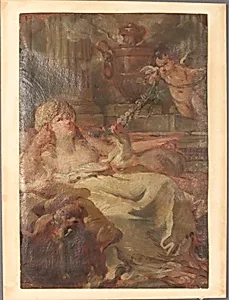
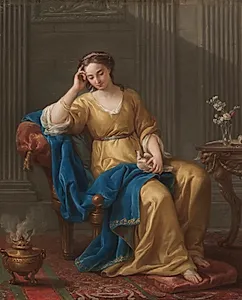
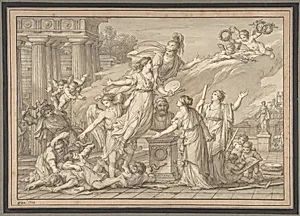
Vien's style marked him as a pioneer of Neoclassicism, blending Rococo sentiment and subtle eroticism with precise, archaeological fidelity to ancient motifs—nude figures in mythological or biblical scenes rendered with smooth, idealized forms. Major works include the Tarascon church series on Saint Martha (1747–1751), such as *Sainte Marthe recevant le Christ à Bethanie*; *Sweet Melancholy* (1756, Cleveland Museum of Art); *The Cupid Seller (La Marchande d'amours)* (1763, Palace of Fontainebleau); *Saint Denis Preaching* (1767, Saint-Roch, Paris); and *Venus, Wounded by Diomedes, Is Saved by Iris* (1775, Columbus Museum of Art). Appointed professor at the Académie in 1759 and director of the French Academy in Rome from 1776 to 1781, he elevated the institution's focus on classical purity. In 1789, he became the last *Premier peintre du Roi* under Louis XVI, a role abolished amid the Revolution.
Though the Revolution disrupted his royal patronage, Vien triumphed at age 80 by winning a government competition in 1796; Napoleon later named him senator. Married to painter Marie-Thérèse Reboul (d. 1806), he fathered a son, Joseph-Marie Vien the younger (1761–1848), also an artist. Vien mentored a generation of painters, including François-André Vincent, Jean-Baptiste Regnault, and Joseph-Benoît Suvée, who advanced stricter Neoclassicism—his pupils carrying forward the movement he helped inaugurate. Buried in the Panthéon, Vien's legacy endures as the vital link from Rococo elegance to revolutionary classicism, his works exemplifying the era's archaeological revival.