
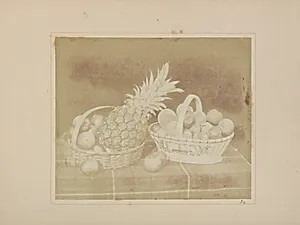
A Fruit Piece
before June 1845
Medium
Salted paper print from paper negative
Classification
Photographs
Department
Photographs
Museum
Metropolitan Museum of Art, New York, NY
Credit
Gift of Jean Horblit, in memory of Harrison D. Horblit, 1994
Accession Number
1994.197.6 (3)
Rights
Public Domain
Tags
Art Historical Context
William Henry Fox Talbot, a pioneering British scientist and inventor, created *A Fruit Piece* before June 1845 as one of the earliest examples of photography used for artistic expression. Talbot developed the calotype process, which employed a paper negative to produce multiple positive prints, fundamentally shaping the medium’s future. This salted paper print captures a simple arrangement of fruit, reflecting the Victorian fascination with natural forms and the still-life tradition. The work demonstrates the technical possibilities of early photography, where long exposure times suited stationary subjects like fruit. Its soft, matte surface and delicate tonal range are hallmarks of salted paper prints, lending an ethereal quality that distinguishes Talbot’s images from sharper daguerreotypes of the era. As a gift to the Metropolitan Museum of Art, this photograph highlights Talbot’s role in elevating photography from scientific experiment to fine art, inviting viewers to appreciate both its historical innovation and quiet beauty.
About the Artist
William Henry Fox Talbot · 1800–1877
William Henry Fox Talbot (1800–1877), a British polymath whose ingenuity transformed visual representation, was born on 11 February 1800 at Melbury House, Dorset, the only child of William Davenport Talbot of Lacock Abbey and Lady Elisabeth Fox Strangways, daughter of the 2nd Earl of Ilchester. His father died shortly after his birth, leaving the family in financial straits until his formidable mo...