
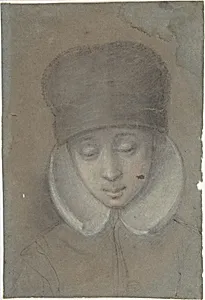
A Girl's Head
17th century (?)
Medium
Black, white and red chalk, on blue paper.
Dimensions
9 3/16 x 6 1/4 in. (23.2 x 15.8 cm)
Classification
Drawings
Department
Drawings and Prints
Museum
Metropolitan Museum of Art, New York, NY
Credit
Gift of Cornelius Vanderbilt, 1880
Accession Number
80.3.542
Rights
Public Domain
Tags
Art Historical Context
### A Girl's Head Nestled in the Metropolitan Museum of Art's Drawings and Prints collection, *A Girl's Head* a delicate 17th-century Flemish drawing, created anonymously around that era. Measuring just 9 3/16 x 6 1/4 inches, this intimate study captures the tender features of a young girl, rendered in black, white, and red on blue paper. Gifted to the museum by Cornelius Vanderbilt in 0, it exemplifies the draftsmanship of Flemish artists during the Baroque period, a time when the Netherlands and Flanders produced masterful works blending realism and emotional depth. The use of the "trois crayons" technique—three colored chalks on toned blue paper—was a hallmark of 17th-century Northern European drawing, allowing artists to achieve lifelike modeling with subtle shadows (black), highlights (white), and warm flesh tones (red). This method, popularized by masters like Rubens and Van Dyck, brought preparatory studies to life, often serving as models for paintings or standalone treasures. Here, the anonymous artist's skill shines in the girl's expressive gaze and soft contours, evoking innocence amid the era's focus on human emotion. Such drawings hold cultural significance as windows into daily life and artistic practice in 17th-century Flanders, where portrait heads were prized for their immediacy. Visitors will appreciate how this modest sheet preserves a fleeting moment, bridging the gap between sketch and masterpiece.
About the Artist
Anonymous, Flemish, 17th century · 1600–1700
**Anonymous, Flemish, 17th century** represents one of the many unidentified painters active in the Southern Netherlands during the Baroque era. Early life details for this artist remain unknown, as is typical for figures whose names have not survived in historical records. No specific teachers or mentors are documented, though the body of work reflects the vibrant artistic environment of Antwerp ...