
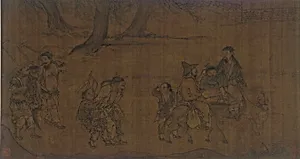
A Group of traveling workmen
Classification
Painting
Department
Smithsonian Collection
Museum
Smithsonian American Art Museum
Credit
Gift of Charles Lang Freer
Accession Number
F1911.539
Rights
Public Domain
Tags
About this artwork
Zhe School
Art Historical Context
*A Group of Traveling Workmen a captivating Ming dynasty (1368–1644) painting from the Zhe School, offers a vivid glimpse into everyday Chinese life. Formerly attributed to the Southern Song master Li Di (active late12th–early 13th century), this work reflects the Zhe painters' skill in emulating earlier Song academy styles while infusing their own professional flair. Emerging from Zhejiang province, the Zhe School was known for its detailed, colorful depictions of landscapes and figures, often commissioned for imperial or elite patrons, blending realism with poetic harmony. The scene portrays a band of itinerant laborers on the move, evoking the rhythms of travel and toil in imperial China. Such genre subjects highlight the Ming era's fascination with ordinary folk amid grand natural settings, underscoring themes of mobility and labor that resonated in a vast, dynamic empire. Zhe artists excelled in meticulous brushwork and vibrant hues, capturing the human spirit against expansive vistas—a technique that bridged classical traditions with Ming vitality. Generously gifted to the Smithsonian American Art Museum by collector Charles Lang Freer, this piece from the Smithsonian Collection invites visitors to ponder the artistry of anonymous craftsmen whose journeys mirrored China's enduring cultural tapestry.