
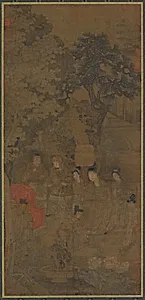
Xin Pi Tugging the Emperor's Robe 辛毗引裾圖
14th century
Classification
Painting
Department
Smithsonian Collection
Museum
Smithsonian American Art Museum
Credit
Gift of Charles Lang Freer
Accession Number
F1917.332
Rights
Public Domain
Tags
About this artwork
When Charles Lang Freer purchased this hanging scroll from Seaouke Yue [You Xiaoqi] in November 1917, it was attributed to the Tang dynasty (618-906) and identified as an episode in the history the tragic Han dynasty heroine, Wang Zhaojun (first century B.C.E.). Since nothing in the traditional representations of the Wang Zhaojun story corresponds in any way with the relationships of the figures in this painting, it is celar that the traditional identification of the subject was incorrect.
Art Historical Context
**Xin Pi Tugging the Emperor Robe** This captivating hanging scroll painting, dated to the 14th, hails from China during the Yuan dynasty (127–1368) or early Ming period (1368–1644). Acquired in 1917 byist Charles Lang Freer dealer Seaouke Yue, it entered the Smithsonian American Art Museum as a gift from his renowned collection of Asian art. Initially misattributed to the Tang (618–906) and linked to the legendary Han dynasty tale of Wang Zhaojun, scholars quickly noted mismatches in the figures' interactions, leading to its reidentification as depicting minister Xin Pi remonstrating with the emperor by tugging his robe—a dramatic symbol of loyal counsel in Chinese history. The scene embodies Confucian ideals of ministerial duty, where advisors boldly intervene to guide rulers, a recurring motif in Chinese imperial narratives. Rendered in traditional ink and color on silk (typical for such scrolls), the composition likely emphasizes hierarchical relationships through posture, gesture, and spatial arrangement, inviting viewers to unroll and contemplate its moral depth. Part of Freer's transformative gift, this work highlights evolving attributions in early 20th-century collecting, bridging Yuan-Ming artistic transitions with their refined, expressive styles. A testament to China's rich storytelling tradition, it reminds us how art preserves elusive historical moments.
About the Artist
Unknown
The artist designated as "Unknown" in our virtual museum's collection exemplifies a poignant chapter in art history: creators whose identities have faded into obscurity despite the enduring power of their work. With only one known artwork attributed to them in our holdings, this figure represents countless anonymous hands that shaped visual culture across centuries. Museums worldwide, including th...