
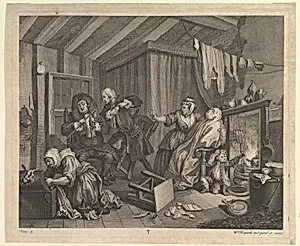
A Harlot's Progress, Plate 5
April 1732
Medium
Etching and engraving; third state of three
Dimensions
plate: 12 5/8 x 15 3/8 in. (32.1 x 39.1 cm) sheet: 13 3/8 x 16 3/16 in. (34 x 41.1 cm)
Classification
Prints
Department
Drawings and Prints
Museum
Metropolitan Museum of Art, New York, NY
Credit
Gift of Sarah Lazarus, 1891
Accession Number
91.1.132
Rights
Public Domain
Tags
Art Historical Context
In William Hogarth's *A Harlot's Progress Plate 5* (April 1732), the viewer confronts the tragic finale of a young woman's moral downfall. This etching and engraving, the third state of three, captures an intimate interior scene teeming with boys, men, and women gathered around a deathbed, underscoring themes of vice, hypocrisy, and mortality. Hogarth, a pioneering English satirist, crafted this as the fifth installment in a six-plate series that traces the protagonist's rapid descent from country innocence to urban ruin, offering a stark cautionary tale for 18th-century audiences. Hogarth's mastery of etching and engraving allowed for intricate details and mass reproduction, making his prints affordable and widely accessible—revolutionary for disseminating social commentary. Here, the medium's fine lines convey crowded chaos: opportunistic mourners, a quack doctor, and a corrupt magistrate, all satirizing London's underbelly of prostitution, disease, and false piety. Printed on a modest 12 5/8 x 15 3/8-inch plate, it exemplifies Hogarth's "modern moral subjects," blending narrative storytelling with biting realism akin to Dutch genre painting. Acquired by the Metropolitan Museum of Art as a gift in 1891, this work remains a cultural touchstone, highlighting Hogarth's enduring critique of societal flaws. Visitors are invited to ponder: in the face of death, who truly grieves?
About the Artist
William Hogarth · 1697–1764
William Hogarth (1697-1764) was an English painter, printmaker, and pictorial satirist who became the first great English-born artist to attract admiration abroad. Born into poverty in London, the son of a failed schoolmaster who was imprisoned for debt, Hogarth's early experiences with the harsh realities of 18th-century urban life profoundly shaped his artistic vision. After apprenticing with si...