
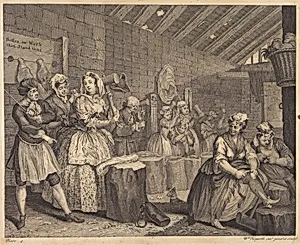
A Harlot's Progress: pl.4
1732
Medium
etching and engraving
Dimensions
sheet: 32.9 × 39.8 cm (12 15/16 × 15 11/16 in.)
Classification
Department
CG-E
Museum
National Gallery of Art, Washington, D.C.
Credit
Rosenwald Collection
Accession Number
1944.5.24
Rights
Public Domain
Art Historical Context
In William Hogarth's *A Harlot's Progress Plate 4* (1732), viewers encounter the fourth installment of the artist's groundbreaking satirical series, etched and engraved on a modest sheet measuring 32.9 × 39.8 cm. This print belongs to Hogarth's innovative "modern moral subjects," sequence of six scenes tracing the tragic downfall of a naive country girl, Moll Hackabout, as she succumbs to the vices of 18th-century London—from seduction and disease to imprisonment and death. Plate 4 captures her in Bridewell prison, laboring at hard tasks amid a chaotic world of corruption, highlighting the harsh realities of poverty and moral decay. Hogarth, a pioneer of English narrative art, masterfully blended etching's fluid lines with engraving's precision to create affordable prints that reached a wide audience, bypassing traditional elite painting markets. Published just months after his mother's death, the series was an instant sensation, sparking piracy and inspiring the 1735 Engraving Copyright Act—Britain's first protection for visual artists. This work exemplifies Hogarth's Rococo-inflected satire, packed with symbolic details critiquing hypocrisy, quackery, and social injustice. Today, housed in the National Gallery of Art's Rosenwald Collection, *Plate 4* invites reflection on enduring themes of ambition, exploitation, and redemption, making Hogarth's vivid storytelling as relevant as ever for museum visitors.
About the Artist
William Hogarth · 1697–1764
William Hogarth (1697-1764) was an English painter, printmaker, and pictorial satirist who became the first great English-born artist to attract admiration abroad. Born into poverty in London, the son of a failed schoolmaster who was imprisoned for debt, Hogarth's early experiences with the harsh realities of 18th-century urban life profoundly shaped his artistic vision. After apprenticing with si...