
A Horseman by a Fence
17th century
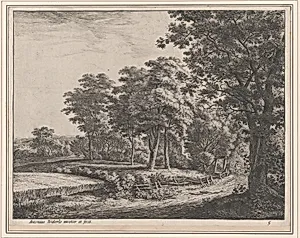
Medium
Etching; third or fourth state of four
Dimensions
sheet: 9 1/8 x 11 3/4 in. (23.1 x 29.8 cm)
Classification
Prints
Department
Drawings and Prints
Museum
Metropolitan Museum of Art, New York, NY
Credit
Harris Brisbane Dick Fund, 1947
Accession Number
47.100.23
Rights
Public Domain
Tags
Art Historical Context
Step into the tranquil world of 17th-century Dutch landscapes with *A Horseman by a Fence*, delicate etching by Anthonie (c. 1609–1690). Created during the Dutch Golden Age, this print captures a solitary rider paused by a rustic fence, evoking the pastoral serenity that captivated artists and collectors of the era. Waterloo, a master etcher and draftsman, specialized in such intimate nature scenes, blending meticulous detail with atmospheric depth. Etching, Waterloo's preferred medium, involves drawing acid-resistant lines into a metal plate, allowing for the fine, expressive strokes that define his style—influenced by Rembrandt and the emerging realist tradition. This impression is from the third or fourth state of four, meaning it reflects later refinements, such as enhanced shading or corrections, making it a prized example of printmaking evolution. At 9 1/8 x 11 3/4 inches, its compact scale invites close viewing, revealing the intricate textures of foliage and fence. Acquired through the Harris Brisbane Dick Fund in 1947, this work resides in the Metropolitan Museum of Art's Drawings and Prints department. It exemplifies how prints democratized art, enabling widespread appreciation of elite landscapes while showcasing Waterloo's enduring legacy in European graphic arts.
About the Artist
Anthonie Waterloo · 1609–1690
Anthonie Waterloo (1609–1690) was a prominent Dutch Golden Age landscape artist, born on May 6 in Lille, then part of the Spanish Netherlands. Little is known of his early life beyond his mother, Magdalena Vaillant, who joined Amsterdam's Walloon Church in 1621, with Waterloo following in 1630; no records exist of formal training, and he was likely self-taught. Registered as a painter in Amsterdam...