
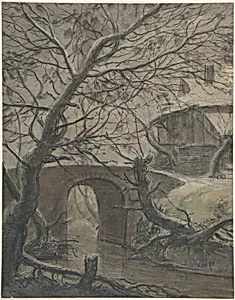
A House near a Bridge
17th century
Medium
charcoal, white chalk and watercolor on gray paper
Dimensions
sheet: 14 x 11 in. (35.5 x 28 cm)
Classification
Drawings
Department
Drawings and Prints
Museum
Metropolitan Museum of Art, New York, NY
Credit
Rogers Fund, 1955
Accession Number
55.59
Rights
Public Domain
Tags
Art Historical Context
In the heart of the Dutch Golden Age, Anthonie Waterloo (c. 1609–1690) crafted *A House near a Bridge*, a delicate 17th-century drawing that captures the serene beauty of the Low Countries' countryside. Working on gray paper—a favored ground for achieving luminous effects—Waterloo masterfully combined charcoal for deep shadows, white chalk for sparkling highlights, and watercolor for subtle color washes. This mixed-media technique, typical of Dutch draftsmen, allowed for rich tonal contrasts and atmospheric depth, turning a simple sheet (14 x 11 inches) into a vivid window on everyday rural life. The composition centers on a modest house nestled beside a bridge, framed by lush trees that evoke the flat, watery landscapes of Holland. Waterloo, influenced by the meticulous naturalism of artists like Rembrandt and the van Ruisdaels, elevated such humble scenes into poetic studies of light and texture. His drawings often served as preparatory works for etchings, blending observation with imaginative detail to celebrate the harmony between human habitation and nature. Acquired through the Rogers Fund in 1955, this piece from the Metropolitan Museum of Art's Drawings and Prints department exemplifies the era's innovative graphic arts. It invites visitors to appreciate how 17th-century artists transformed paper into evocative landscapes, reflecting a cultural shift toward valuing the ordinary wonders of the world around them.
About the Artist
Anthonie Waterloo · 1609–1690
Anthonie Waterloo (1609–1690) was a prominent Dutch Golden Age landscape artist, born on May 6 in Lille, then part of the Spanish Netherlands. Little is known of his early life beyond his mother, Magdalena Vaillant, who joined Amsterdam's Walloon Church in 1621, with Waterloo following in 1630; no records exist of formal training, and he was likely self-taught. Registered as a painter in Amsterdam...