
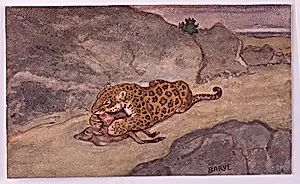
A Jaguar Devouring a Deer
after 1840
Medium
transfer watercolor on heavy wove paper
Dimensions
5 5/8 x 9 5/16 in. (14.3 x 23.7 cm)
Classification
Drawings
Department
Robert Lehman Collection
Museum
Metropolitan Museum of Art, New York, NY
Credit
Robert Lehman Collection, 1975
Accession Number
1975.1.568
Rights
Public Domain
Tags
Art Historical Context
In the Robert Lehman Collection at The Metropolitan Museum of Art,-Louis Barye's *A Jaguar Devouring a* (after 1840) captures raw moment of nature's ferocity. This intimate drawing, measuring just 5⅝ × 9¼ inches, depicts a powerful jaguar mid-feast on its prey, embodying Barye's lifelong fascination with wild animals. A leading French sculptor of the Romantic era (1796–1875), Barye pioneered the *animalier* style—istic, anatomically precise portrayals of beasts that bridged fine art and natural history, influencing generations of sculptors. Rendered in transfer watercolor on heavy wove paper, the work showcases Barye's masterful technique for studies and preparatory sketches. Transfer watercolor allowed for subtle tonal effects and fluid details, transferring pigment indirectly to achieve velvety textures ideal for fur, muscle, and blood. Created after 1840, during Barye's mature period, it reflects his meticulous observation of live animals at Paris zoos, blending dramatic tension with scientific accuracy—a hallmark of 19th-century French animal art. This piece invites visitors to ponder humanity's awe for the wild, much like Barye's bronze sculptures in major museums. A gem of the Lehman Collection (acquired 1975), it highlights how drawings fueled the era's sculptural innovations.
About the Artist
Antoine-Louis Barye · 1795–1875
Antoine-Louis Barye (1795–1875) was born in Paris on September 24, the son of goldsmith Pierre Barye and Marguerite Barye. Following family tradition, he apprenticed as a goldsmith under his father and, around 1810, with Martin-Guillaume Biennais, goldsmith to Napoleon. After brief military service, Barye pursued sculpture, studying under François-Joseph Bosio in 1816 and painter Baron Antoine-Jea...