
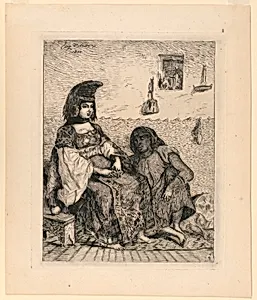
A Jewish Woman of Algiers
Medium
Classification
Department
Smithsonian Collection
Museum
Smithsonian American Art Museum
Credit
Smithsonian American Art Museum
Accession Number
1896-31-99
Rights
Public Domain
About this artwork
Research in Progress
Art Historical Context
Eugène Delacroix, a leading figure of French Romanticism, created *A Jewish Woman of Alg* in 1833, shortly after his transformative trip to North Africa in 1832. Accompanying a French diplomatic mission amid the recent conquest of Algeria (1830), Delacroix immersed himself in the vibrant cultures of Algiers and Morocco. This print captures the exotic allure that captivated European artists during the Orientalist movement, portraying a Jewish woman as a symbol of the region's diverse ethnic tapestry. As a print—likely a lithograph, a medium Delacroix mastered for its fluid expressiveness—this work exemplifies his innovative technique. Romanticism emphasized emotion, color, and the exotic over classical restraint, and Delacroix's loose, dynamic lines evoke the sensuous textures of North African life, from flowing garments to intricate jewelry. Though smaller in scale than his grand oils like *Women of Algiers* (1834), it distills the same intense observation and dramatic lighting. Housed in the Smithsonian American Art Museum, this piece highlights Delacroix's role in bridging Eastern and Western visual traditions, influencing later artists from Renoir to Matisse. It invites visitors to ponder the interplay of cultural encounter and artistic imagination in 19th-century Europe. (198 words)