
A Lectern Cloth with the Marriage at Cana
c. 1400
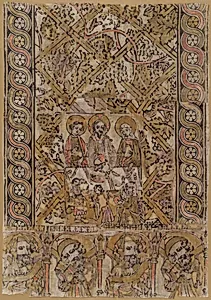
Medium
woodcut on linen, hand-colored in brown and red
Dimensions
overall (fragment): 120.7 x 85.1 cm (47 1/2 x 33 1/2 in.)
Classification
Department
CG-E
Museum
National Gallery of Art, Washington, D.C.
Credit
Rosenwald Collection
Accession Number
1949.5.81
Rights
Public Domain
Art Historical Context
This rare lectern cloth, titled *A Lectern Cloth with Marriage at Cana*, hails from Germany around 1400, capturing the biblical miracle from the Gospel of John where Jesus transforms water into wine at a wedding feast. Created as a woodcut printed on linen and meticulously hand-colored in earthy browns and reds, this substantial fragment measures nearly 48 by 33 inches, suggesting it once draped a church lectern during services, blending art with liturgy. As one of the earliest known examples of printing on fabric, it showcases pioneering 15th-century techniques: a woodblock carved with the scene was inked and pressed onto linen, then enhanced by hand for vivid detail. This method democratized religious imagery, making grand narratives accessible beyond illuminated manuscripts, which were costly and labor-intensive. German workshops of the era were at the forefront of such innovations, paving the way for the print revolution. Housed in the National Gallery of Art's Rosenwald Collection, this artifact highlights the intersection of devotion and craftsmanship in late medieval Europe. Its survival as a textile print offers a tactile glimpse into how faith was visually celebrated in communal worship, inviting us to ponder the wedding guests' awe amid the cloth's faded yet enduring hues.
About the Artist
German 15th Century · 1400–1500
**German 15th Century** The designation "German 15th Century" encompasses a collective of anonymous artists active in the late medieval and early Renaissance periods in Germany, primarily known through their contributions to early printmaking and panel painting. These creators emerged during a transformative era when woodcuts and engravings began democratizing religious imagery, bridging the Goth...