
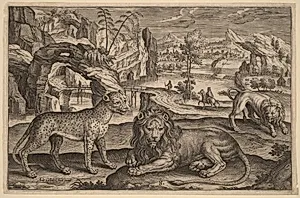
A Leopard and Two Lions
c. 1597
Medium
engraving on laid paper
Dimensions
plate: 12.3 × 19 cm (4 13/16 × 7 1/2 in.) sheet: 12.7 × 19.4 cm (5 × 7 5/8 in.)
Classification
Department
CG-E
Museum
National Gallery of Art, Washington, D.C.
Credit
Ailsa Mellon Bruce Fund
Accession Number
1972.28.82
Rights
Public Domain
Art Historical Context
Adriaen Collaert's *A Leopard and Two Lions created around 1597, is a masterful engraving on laid paper that captures the power and elegance of wild beasts. Collaert, a prominent Flemish engraver from Antwerpc. 1560–1618), belonged to a dynasty of printmakers and specialized in intricate depictions of animals, often drawing from designs by contemporaries like Jan van der Straet (Stradanus). This-scale work (plate: 12.3 × 19 cm) exemplifies the Northern Renaissance's fascination with natural history, as Europe’s Age of Exploration brought tales—and sometimes images—of exotic creatures into artistic repertoires. The engraving technique shines here: Collaert incised fine lines into a copper plate, creating rich contrasts of texture—from the leopard's spotted fur to the lions' flowing manes and taut muscles. Printed on laid paper, which reveals subtle chain lines under light, the print allowed for widespread dissemination, serving as both art and study aid for scholars and collectors. Its dynamic composition, with the animals poised in tense confrontation, reflects Mannerist tendencies toward elongated forms and dramatic tension. Housed in the National Gallery of Art through the Ailsa Mellon Bruce Fund (Department CG-E), this print highlights printmaking's role in 16th-century visual culture, bridging fine art and scientific observation. Visitors will appreciate its timeless appeal, evoking the thrill of encountering Africa's kings in a quiet gallery space.