
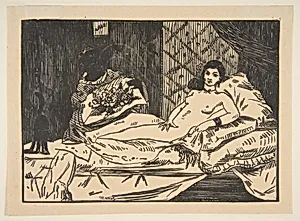
Olympia
published 1902
Medium
Wood engraving on laid paper
Dimensions
block: 5 3/16 x 7 5/16 in. (13.2 x 18.5 cm) sheet: 5 7/8 x 8 in. (15 x 20.3 cm)
Classification
Prints
Department
Drawings and Prints
Museum
Metropolitan Museum of Art, New York, NY
Credit
Bequest of Scofield Thayer, 1982
Accession Number
1984.1203.84
Rights
Public Domain
Tags
Art Historical Context
This wood engraving of Olympia, created after the original 1863 painting by Édouard Manet and published in 1902, captures one of the most provocative female nudes in modern art. Manet, a pivotal figure bridging Realism and Impressionism, presented the subject as a contemporary Parisian courtesan reclining with direct gaze and confident posture, challenging the idealized mythological nudes of earlier traditions. The print medium—wood engraving on laid paper—allowed wider circulation of this bold image decades after the painting’s debut. The work’s artistic significance lies in its unflinching realism and social commentary, which sparked controversy when first exhibited. By rendering the figure with modern accessories rather than classical drapery, Manet questioned artistic conventions and viewer expectations. This 1902 impression, now in the Metropolitan Museum of Art’s collection, preserves that daring spirit through precise line work typical of wood engraving, offering museum visitors a tangible link to a landmark moment in art history.
About the Artist
Edouard Manet|Moller · 1832–1883
Édouard Manet (1832-1883) was a French painter who played a pivotal role in the transition from Realism to Impressionism, often called the 'Father of Modern Art.' Born into a wealthy Parisian family, Manet defied his father's wishes for a legal career to pursue painting, studying under academic artist Thomas Couture. His revolutionary works 'Le Déjeuner sur l'herbe' and 'Olympia' (both 1863) scand...