
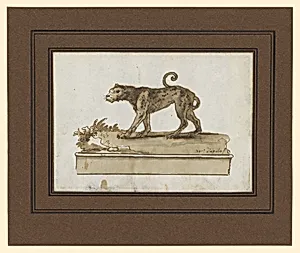
A Leopard, Moving to the Left (on a Base)
mid-18th–early 19th century
Medium
Pen and brown ink, brown wash, over traces of black chalk
Dimensions
4 7/16 x 6 7/16 in. (11.2 x 16.4 cm)
Classification
Drawings
Department
Robert Lehman Collection
Museum
Metropolitan Museum of Art, New York, NY
Credit
Robert Lehman Collection, 1975
Accession Number
1975.1.517
Rights
Public Domain
Tags
Art Historical Context
In the opulent world of 18th-century Venetian art, Giovanni Domenico Tiep, son of the illustrious Giovanni Battista Tiepolo, this lively drawing *A Leopard, Moving to Left (on a Base around the mid-18th to 19th century. a master draftsman in the Rococo tradition, Giandomenico was renowned for his fluid, expressive sketches that captured the energy of animals and figures alike. This small-scale study (just 4 7/16 x 6 7/16 inches) likely served as a preparatory exercise or standalone gem, showcasing his keen observation of wildlife amid Europe's fascination with exotic beasts. Executed in pen and brown ink with brown wash over faint black chalk underdrawing, the work exemplifies Tiepolo's virtuoso technique. The precise ink lines define the leopard's sleek musculature and poised stride, while the translucent wash adds depth and shadow, evoking a sense of motion on an implied pedestal base. Such methods allowed for quick, atmospheric effects prized in Venetian workshops, where drawings bridged painting and fresco design. Housed in the Robert Lehman Collection at The Metropolitan Museum of Art since 1975, this piece invites visitors to marvel at Tiepolo's playful yet anatomical precision. Leopards, symbols of ferocity and grace, highlight the era's blend of naturalism and fantasy—perfect for animal lovers exploring the Met's treasure trove of drawings.
About the Artist
Giovanni Domenico Tiepolo · 1727–1804
Giovanni Domenico Tiepolo (1727-1804) was a Venetian painter, printmaker, and draftsman whose career spanned the twilight of the Rococo era. Born on August 30, 1727, in Venice as the eldest son of the celebrated Giovanni Battista Tiepolo, he worked both in his father's shadow and as a significant independent artist who developed a distinctly earthbound and humanistic vision. Domenico's importance...