
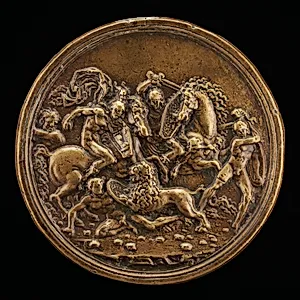
A Lion-Hunt
late 15th - early 16th century
Medium
bronze//Light brown patina
Dimensions
overall (diameter): 8.26 cm (3 1/4 in.) gross weight: 96.85 gr (0.214 lb.)
Classification
Sculpture
Department
CSD
Museum
National Gallery of Art, Washington, D.C.
Credit
Samuel H. Kress Collection
Accession Number
1957.14.341
Rights
Public Domain
Art Historical Context
Behold *A Lion-Hunt*, a captivating bronze plaquette crafted by the Italian artist known as Moderno (Galeazzo Mondella) the late 15th early 16th century Measuring just 8.26 cm in diameter and weighing under 100 grams, this intimate sculpture exemplifies the Renaissance fascination with small-scale bronzes, prized by collectors for their portability and refined detail. Its light brown patina, a natural oxidation over centuries, enhances the work's warm, aged allure, evoking the thrill of a dynamic chase. During the Italian Renaissance, artists like Moderno elevated bronze plaquettes—thin, medal-like reliefs—into miniature masterpieces, blending classical antiquity's vigor with emerging naturalism. Lion hunts, a motif rooted in ancient myths and medieval tapestries, symbolized bravery, nobility, and the triumph of human skill over wild nature. Moderno's skilled chasing and modeling likely capture the tension of spears, rearing beasts, and mounted hunters in exquisite low relief, showcasing the period's mastery of lost-wax casting techniques. Housed in the National Gallery of Art's Samuel H. Kress Collection, this piece invites visitors to ponder the era's blend of artistry and adventure. Though small, it packs the roar of history into your palm.
About the Artist
Moderno · 1467–1528
Galeazzo Mondella, known to history as Moderno, was born in Verona in 1467 and became one of the most accomplished and widely admired creators of bronze plaquettes during the Italian Renaissance. He joined the Goldsmiths' Guild of Verona in 1485 at the age of eighteen, and by 1487 he had begun working at the court of Mantua, where he adopted the name Moderno—chosen in deliberate counterpoint to hi...