
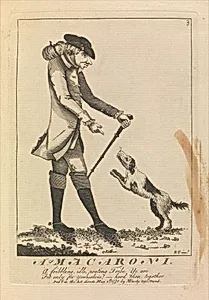
A Macaroni
May 4, 1771
Medium
Etching
Dimensions
plate: 6 x 4 3/16 in. (15.3 x 10.6 cm) sheet: 8 13/16 x 5 7/16 in. (22.4 x 13.8 cm)
Classification
Prints
Department
Drawings and Prints
Museum
Metropolitan Museum of Art, New York, NY
Credit
The Elisha Whittelsey Collection, The Elisha Whittelsey Fund, 2011
Accession Number
2011.88(4)
Rights
Public Domain
Tags
Art Historical Context
Step into the satirical world of 18th London with *A Macaroni*, an created by Matthew Darly, Darly, and Edward Topham on May 4, 1771. This petite print (plate: 6 x 4 3/16 in.) captures the exaggerated fashions of the "Macaroni" dandies—young British gentlemen who returned from their Grand Tours in Italy sporting outlandish Continental styles, from towering powdered wigs to ornate suits and accessories. Often accompanied by pampered dogs, these figures symbolized excess and cultural pretension, ripe for ridicule. The Darlys, a husband-and-wife team renowned for their prolific output of caricatures, collaborated with satirist Edward Topham to produce this sharp commentary. Etching, their chosen medium, allowed for intricate lines and tonal effects through acid-etched copper plates, making affordable yet detailed prints accessible to a wide audience via London's print shops. This technique amplified the caricature's humorous distortions, poking fun at social climbers amid the opulence of Georgian society. Housed in the Metropolitan Museum of Art's Drawings and Prints department (The Elisha Whittelsey Collection, 2011), *A Macaroni* exemplifies the era's vibrant print culture, blending wit with social critique. It reminds us how art has long mirrored—and mocked—fashion's fleeting fads.
About the Artist
Matthew Darly|Mary Darly|Edward Topham · 1720–1780
**Matthew Darly (also known as Matthias Darly, c. 1720–1780)** was a versatile British printseller, engraver, caricaturist, and furniture designer active in London throughout the mid-to-late eighteenth century. His early training began with an apprenticeship in 1735 to clockmaker Umfraville Sampson. He later established himself as a prominent figure in the print trade, operating shops known as “T...