
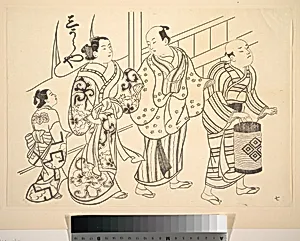
A Man Attended by a Servant Carrying a Lantern
Medium
Monochrome woodblock print; ink on paper
Dimensions
10 1/4 x 14 11/16 in. (26 x 37.3 cm)
Classification
Prints
Culture & Period
Japan · Meiji period (1868–1912)
Department
Asian Art
Museum
Metropolitan Museum of Art, New York, NY
Credit
H. O. Havemeyer Collection, Bequest of Mrs. H. O. Havemeyer, 1929
Accession Number
MJP34
Rights
Public Domain
Tags
Art Historical Context
In the hushed glow of a lantern, Okumura Masanobu's *A Man Attended by a Carrying a Lantern* captures moment of quiet nocturnal companionship. This monochrome woodblock print rendered in ink on paper, 10¼ × 14⅞ inches and hails from Japan's Meiji period (1868–1912), a time of rapid modernization blending tradition with Western influences. Part of the Museum of Art's Asian collection, it entered through renowned H. O.emeyer bequest in 9, reflecting early th-century Western fascination with prints. Masanobu a pioneering ukiyo artist known for his innovative printing techniques, here employs the stark elegance of sumizuri-e—single-color ink printing—to evoke depth and drama. Lanterns, a recurring motif in Japanese art, symbolize evening rituals, festivals, or urban nightlife, illuminating the intimate hierarchy between the poised central figure and his attentive servant. This scene whispers of Edo-period social customs persisting into Meiji, where everyday human interactions were elevated to art. As a window into Japan's "floating world," the print showcases woodblock's precision: intricate carving and subtle shading from layered ink applications. Visitors, imagine wandering Tokyo's lantern-lit streets—this intimate work invites you to pause and ponder the enduring poetry of light and shadow.
About the Artist
Okumura Masanobu · 1686–1764
Japanese, 1686–1764