
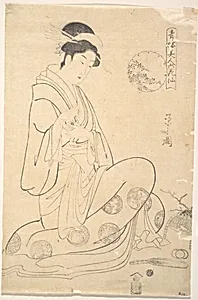
Konosato of Takeya Seated, Holding an Incense Burner
Medium
Monochrome woodblock print; ink on paper
Dimensions
H. 13 5/8 in. (34.6 cm); W. 8 15/16 in. (22.7 cm)
Classification
Prints
Culture & Period
Japan · Edo period (1615–1868)
Department
Asian Art
Museum
Metropolitan Museum of Art, New York, NY
Credit
H. O. Havemeyer Collection, Bequest of Mrs. H. O. Havemeyer, 1929
Accession Number
JP1782
Rights
Public Domain
Tags
Art Historical Context
This elegant monochrome woodblock print by Chōbunsai Eishi portrays Konosato, a courtesan from the Takeya house, seated gracefully while holding an incense burner. Created during Japan’s Edo period (1615–1868), the work belongs to the ukiyo-e tradition of bijin-ga, or “pictures of beautiful women,” which celebrated the refined allure of entertainers and courtesans in urban culture. Eishi, a prominent artist of the late 18th century, was known for his refined, elongated figures and subtle expressions that conveyed both poise and quiet introspection. Printed in ink on paper, the artwork demonstrates the expressive potential of sumizuri-e, or monochrome printing. Without color, the viewer’s attention focuses on the delicate line work, the soft gradations of ink, and the balanced composition—qualities that made such prints both affordable and widely admired. The incense burner adds a layer of sensory suggestion, evoking the refined rituals and fleeting pleasures associated with the pleasure quarters of Edo-period Japan. Now part of the Metropolitan Museum of Art’s Asian Art collection through the H. O. Havemeyer bequest, this print preserves a moment of cultivated elegance from a vibrant era of Japanese artistic innovation.
About the Artist
Chōbunsai Eishi · 1756–1829
Japanese, 1756–1829