
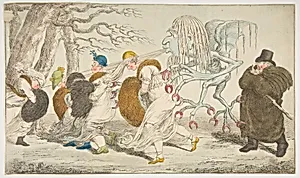
A Naked Truth, or Nipping Frost
February 2, 1803
Medium
Hand-colored etching
Dimensions
sheet: 8 5/8 x 14 3/4 in. (21.9 x 37.4 cm)
Classification
Prints
Department
Drawings and Prints
Museum
Metropolitan Museum of Art, New York, NY
Credit
Rogers Fund and The Elisha Whittelsey Collection, The Elisha Whittelsey Fund, 1969
Accession Number
69.524.43
Rights
Public Domain
Tags
Art Historical Context
**A Naked Truth, or Nipping** is a lively hand-colored etching created by British caricaturist Charles Williams published by S.W. Fores on February 2 1803. Measuring 8⅝ × 14¾ inches, this satirical print captures the Regency era's penchant for humorous commentary through exaggerated visuals. Hand-coloring, a hallmark of early 19th-century British prints, brought these etchings to life with vibrant hues, making them affordable and popular souvenirs sold in London shops for the middle class. The title cleverly plays on the phrase "naked truth," equating harsh reality with a "nipping frost"—a biting winter wind that exposes vulnerabilities. Tags like "Satire," "Men," "Women," and "Wind" suggest a comedic scene of blustery chaos, likely poking fun at social pretensions or political figures through disheveled clothing and surprised expressions. Such prints were a vital part of Britain's vibrant caricature culture, critiquing society amid the Napoleonic Wars and rapid urbanization. Housed in the Metropolitan Museum of Art's Drawings and Prints department (acquired via Rogers Fund and The Elisha Whittelsey Collection in 1969), this work exemplifies etching's precision for sharp lines and witty details. It invites visitors to chuckle at timeless human foibles while appreciating how satire shaped public discourse in Georgian England.
About the Artist
Charles Williams|S. W. Fores · 1797–1830
Charles Williams (1797–1830) was a British caricaturist and printmaker who worked in London during the final decades of the Georgian era, producing satirical prints for the thriving trade in political and social caricature that flourished in the city's print shops. He worked in the tradition established by such masters as James Gillray and Thomas Rowlandson, whose biting visual commentary on polit...