
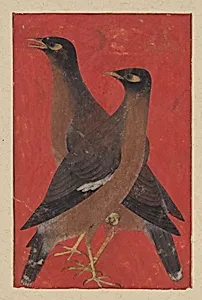
A Pair of Mynas
Unknown Artist
ca. 1620
Medium
Opaque color on paper
Dimensions
Image: 5 3/4 × 3 3/4 in. (14.6 × 9.5 cm) Frame: 9 × 6 15/16 × 9/16 in. (22.9 × 17.6 × 1.4 cm)
Classification
Codices
Department
Islamic Art
Museum
Metropolitan Museum of Art, New York, NY
Credit
Howard Hodgkin Collection, Purchase, Florence and Herbert Irving Acquisitions, Harris Brisbane Dick, and 2020 Benefit Funds; Howard S. and Nancy Marks, Lila Acheson Wallace, and Friends of Islamic Art Gifts; Louis V. Bell, Harris Brisbane Dick, Fletcher, and Rogers Funds and Joseph Pulitzer Bequest; and funds from various donors, 2022
Accession Number
2022.178
Rights
Public Domain
Tags
Art Historical Context
Nestled within the Islamic Art collection at the Metropolitan Museum of Art, *A Pair of Mynas* (ca. 1620) is a delicate folio from a codex, the anonymous artist's mastery of opaque watercolor on paper. Measuring just 5 3/4 × 3 3/4 inches, this intimate painting captures two mynas—vibrant, chatty birds native to South Asia—in exquisite detail. Their sleek feathers, expressive eyes, and poised stances evoke the natural world's quiet poetry, rendered with the precision typical of 17th-century Islamic miniatures. Created during the height of the Safavid or early Mughal eras, such works often adorned luxurious manuscripts, albums, or encyclopedias of nature. Opaque pigments allowed for bold, jewel-like colors that endured on paper, a technique honed in Persianate workshops where artists blended observation with stylized elegance. Mynas, symbols of eloquence and mimicry in Islamic poetry and folklore, highlight the cultural reverence for birds as messengers between earth and divine. This gem from the Howard Hodgkin Collection invites visitors to marvel at how tiny surfaces held vast artistic ambition, bridging science, beauty, and spirituality in a pre-modern world.