
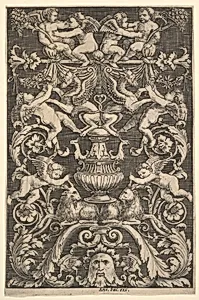
A panel of ornament with putti, goat and other figures
Medium
Engraving
Dimensions
sheet: 8 11/16 x 5 11/16 in. (22 x 14.5 cm)
Classification
Prints
Department
Drawings and Prints
Museum
Metropolitan Museum of Art, New York, NY
Credit
The Elisha Whittelsey Collection, The Elisha Whittelsey Fund, 1949
Accession Number
49.97.342
Rights
Public Domain
Tags
Art Historical Context
This enchanting engraving, titled *A Panel of Ornament with Putti, and Other Figures*, dates to 1530–60 and hails from the vibrant world of Renaissance Italy. Attributed to the Master of Die after designs possibly by Perino del V (also known as Pietro Buonacc), a leading Mannerist artist who collaborated with Raphael, and published by Antonio Salamanca, it the era's fascination with intricate decorative motifs. Measuring just 8 11/16 x 5 11/16 inches, small-scale print from the Metropolitan Museum of Art's Elisha Whittelsey Collection was part of a broader tradition of pattern books that disseminated ornamental designs across Europe. The composition bursts with playful grotesques—chubby putti (cherubic children), goats, sphinxes, and fantastical figures intertwined in a harmonious yet whimsical symmetry. Engraving, a precise intaglio technique using a burin to incise metal plates, allowed for fine details and tonal depth, making it ideal for replicating elaborate drawings. These prints influenced architecture, textiles, and metalwork, bridging ancient Roman discoveries (like Nero's Domus Aurea) with 16th-century Mannerist exuberance. As a product of Rome's bustling print workshops, this panel highlights the cultural exchange of the High Renaissance, where mythical creatures symbolized fertility, playfulness, and the grotesque sublime. Visitors will appreciate its role in democratizing high art through affordable reproductions, sparking creativity far beyond palace walls.
About the Artist
Master of the Die|Perino del Vaga (Pietro Buonaccorsi)|Antonio Salamanca · 1525–1560
**Master of the Die** (fl. 1525–1560) was an anonymous Italian engraver and printmaker active primarily in Rome during the mid-16th century. Named for the distinctive small die he used to sign his prints—a tiny emblematic mark that became his moniker—this elusive artist remains unidentified despite scholarly proposals linking him to figures like Benedetto Verino, Giovanni Francesco Zabello, Tommas...