
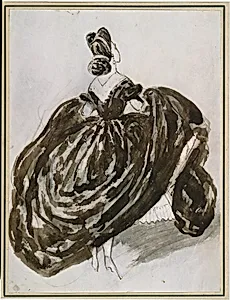
A Parisienne Seen from the Back
1850s(?)
Medium
graphite, brown ink, gray and brown wash on buff wove paper darkened through exposure to light
Dimensions
9 13/16 x 7 5/16 in. (24.9 x 18.6 cm)
Classification
Drawings
Department
Robert Lehman Collection
Museum
Metropolitan Museum of Art, New York, NY
Credit
Robert Lehman Collection, 1975
Accession Number
1975.1.638
Rights
Public Domain
Tags
Art Historical Context
In the bustling streets of 1850s Paris, Guys captured the essence of modern urban life with his swift, evocative sketches. *A Parisienne Seen from Back*, a delicate drawing from this era, showcases a fashionable woman viewed from behind, her silhouette evoking the grace and style of the Second Empire. Guys, celebrated by poet Charles Baudelaire as the "painter of modern life," was a master chronicler of Parisian society, sketching flâneurs, dandies, and elegant women amid the city's transformation under Baron Haussmann. Rendered in graphite, brown ink, and subtle gray and brown washes on buff wove paper, this intimate work (9 13/16 x 7 5/16 in.) highlights Guys' fluid technique, blending precise lines with atmospheric shading to suggest movement and texture. The paper's darkening from light exposure adds a poignant layer, reminding us of time's gentle toll on these fragile artifacts. Housed in the Robert Lehman Collection at The Metropolitan Museum of Art since 1975, it exemplifies Guys' influence on later movements like Impressionism, prioritizing fleeting moments over polished perfection. This drawing invites visitors to ponder the allure of anonymity—a stylish Parisienne, forever poised on the threshold of modernity, her back turned yet radiating cultural vibrancy.
About the Artist
Constantin Guys · 1802–1892
Constantin Guys, born Ernest-Adolphe-Hyacinthe-Constantin Guys de Saint-Hélène on December 3, 1802, in Vlissingen, Netherlands, to French parents François Lazare Guys and Elisabeth Bétin, spent his early years in a naval family that relocated to Calais around 1805. His early life is not well documented, with no records of formal art training, teachers, or schools; Guys appears to have been largely...