
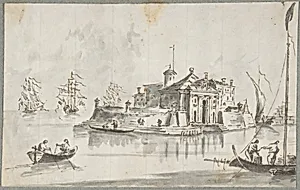
A Port near Venice: Chioggia (?)
1764–1835
Medium
Pen and brown ink, brush and gray wash
Dimensions
4 9/16 x 7 5/16in. (11.6 x 18.5cm)
Classification
Drawings
Department
Drawings and Prints
Museum
Metropolitan Museum of Art, New York, NY
Credit
Bequest of Alexandrine Sinsheimer, 1958
Accession Number
59.23.46
Rights
Public Domain
Tags
Art Historical Context
Giacomo Guardi, son of the renowned Venetian vedutista Francesco Guardi, crafted this intimate drawing titled *A Port near Venice: Chi (?) * sometime between 1764 and 1835. Depicting a lively harbor scene alive with boats and ships, evokes the bustling maritime world of Venice's lagoon towns like Chioggia, a historic fishing port southeast of the city. Guardi's work continues his father's legacy of capturing the shimmering light and fluid architecture of the Venetian landscape, offering visitors a window into 18th- and early 19th-century lagoon life. Executed in pen and brown ink with brush and gray wash on a modest scale (4 9/16 x 7 5/16 inches), the piece showcases Guardi's mastery of mixed media. The fine ink lines define boats and structures with precision, while soft gray washes build atmospheric depth, mimicking the reflective waters and hazy skies typical of Venetian views. Such drawings often served as studies for larger paintings or cherished standalone works, highlighting the Guardi family's innovative approach to topography and mood. Housed in the Metropolitan Museum of Art's Drawings and Prints department through the 1958 bequest of Alexandrine Sinsheimer, this gem underscores Venice's enduring cultural allure as a nexus of trade, travel, and artistry. A delightful study in subtlety, it invites you to linger on the everyday poetry of the port.
About the Artist
Giacomo Guardi · 1764–1835
Giacomo Guardi (1764–1835) was a Venetian painter who worked in the long shadow of his celebrated father, Francesco Guardi, one of the greatest vedutisti — view painters — of the eighteenth century. Born into one of Venice's most prominent artistic families, Giacomo received his training directly from his father, absorbing both the technical methods and the characteristic style that had made Franc...