
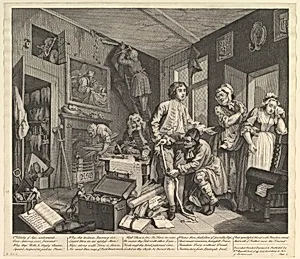
A Rake's Progress, Plate 1
June 25, 1735
Medium
Etching and engraving; first state of three
Dimensions
sheet: 13 7/8 x 15 7/8 in. (35.2 x 40.4 cm)
Classification
Prints
Department
Drawings and Prints
Museum
Metropolitan Museum of Art, New York, NY
Credit
Harris Brisbane Dick Fund, 1932
Accession Number
32.35(28)
Rights
Public Domain
Tags
Art Historical Context
**A Rake's Progress Plate 1** (1735) marks the dramatic opening of William Hogarth's satirical masterpiece, a series of eight prints chronicling the moral downfall of a young heir named Tom Rakewell. in collaboration with Dr. Johnoadley, who contributed accompanying verses, this etching and engraving captures Hogarth's signature style of social commentary. Issued on June 25, 1735, as the first state of three an early proof before later refinements exemplifies 18th-century British printmaking at its peak, blending intricate line work with biting wit to critique the excesses of Georgian society. Hogarth, a pioneer of narrative art, drew from everyday life to expose the follies of the wealthy and idle, contrasting them with working men and women in the bustling scene. The medium of etching and engraving allowed for detailed, reproducible imagery that reached a wide audience, making moral lessons accessible beyond elite viewers. Measuring 13 7/8 x 15 7/8 inches, this plate sets the stage for Tom's inheritance-fueled debauchery, inviting viewers to reflect on ambition's perils. Housed in the Metropolitan Museum of Art's Drawings and Prints department (Harris Brisbane Dick Fund, 1932), it remains a cultural touchstone, influencing everything from literature to modern comics. Step closer and let Hogarth's vivid world remind you: fortune favors the prudent.
About the Artist
William Hogarth|Dr. John Hoadley · 1697–1764
William Hogarth (1697-1764) was an English painter, printmaker, and pictorial satirist who became the first great English-born artist to attract admiration abroad. Born into poverty in London, the son of a failed schoolmaster who was imprisoned for debt, Hogarth's early experiences with the harsh realities of 18th-century urban life profoundly shaped his artistic vision. After apprenticing with si...