
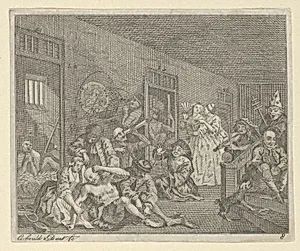
A Rake's Progress, Plate 8
Medium
Engraving
Dimensions
Sheet: 2 9/16 x 3 1/8 in. (6.5 x 8 cm)
Classification
Prints
Department
Drawings and Prints
Museum
Metropolitan Museum of Art, New York, NY
Credit
Harris Brisbane Dick Fund, 1932
Accession Number
32.35(165)
Rights
Public Domain
Tags
Art Historical Context
**A Rake's Progress, Plate 8** is the climactic final installment in William Hogarth's iconic 1735 series of moralistic prints, here reproduced as a delicate engraving around 1800, possibly with contributions from engravers Dent and Richard Corbould. Hogarth, a pioneering English artist, crafted this narrative sequence to satirize the downfall of Tom Rakewell, a young heir who squanders his fortune on vice. Measuring just 2 9/16 x 3 1/8 inches, this intimate print captures the rake's grim end in London's Fleet Prison, surrounded by men, women, musicians, and violins—a chaotic tableau of fleeting revelry amid despair. Hogarth's satirical style, blending Rococo exuberance with sharp social commentary, made these prints wildly popular, allowing mass dissemination through engraving techniques that etched intricate details into copper plates for reproduction. Plate 8 underscores 18th-century themes of moral decay, debtors' prisons, and the perils of hedonism, resonating with audiences from London's underbelly to moral reformers. The vivid depiction of musicians entertaining the imprisoned rake highlights Hogarth's genius for storytelling, packing tragedy and irony into a single frame. Acquired through the Harris Brisbane Dick Fund in 1932, this print from the Metropolitan Museum of Art's Drawings and Prints department invites visitors to ponder timeless warnings about excess. A masterful blend of wit and warning, it remains a cornerstone of British satirical art.
About the Artist
William Hogarth|Dent|Richard Corbould · 1697–1764
William Hogarth (1697-1764) was an English painter, printmaker, and pictorial satirist who became the first great English-born artist to attract admiration abroad. Born into poverty in London, the son of a failed schoolmaster who was imprisoned for debt, Hogarth's early experiences with the harsh realities of 18th-century urban life profoundly shaped his artistic vision. After apprenticing with si...